Politics1772 · 1793 · 1795

Partitions of Poland

Also called: Partition of Poland, Constitution of 3 May 1791

In three partitions in 1772, 1793 and 1795, Russia, Prussia and Austria divided up the lands of the Polish–Lithuanian Commonwealth; Poland disappeared from the map until 1918.
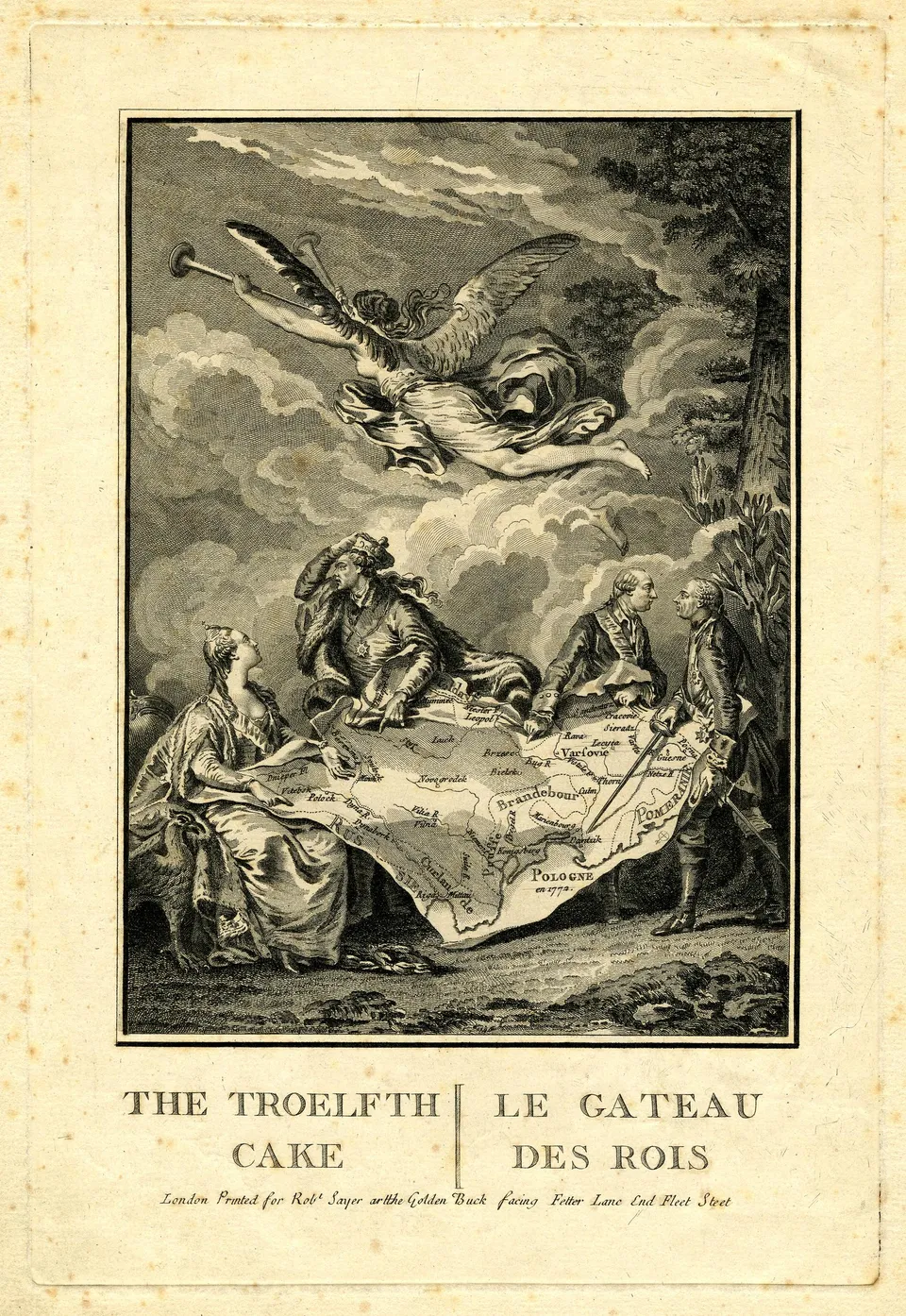
“The Troelfth Cake” — satirical print of the first partition, with four monarchs around a map of “Poland in 1772”; Noël Le Mire, 1773 (British Museum)

Print made by: Noël Le Mire After: Jean Michel Moreau le jeune Published by: Robert Sayer · Public domain · Source

Once a great power of eastern Europe, the Polish–Lithuanian Commonwealth was an elective monarchy in which the nobles chose the king, and the “liberum veto”, which let a single deputy block any decision of the Sejm, kept the central government weak. Taking advantage, its powerful neighbours seized about a third of its territory in the first partition of 1772.

Poland turned to reform and on 3 May 1791 adopted Europe’s first modern written constitution, but Russia invaded and in 1793 Russia and Prussia partitioned it again. When the uprising led by Kościuszko (1794) was crushed, the three powers divided the rest in 1795 and Poland vanished. Poles kept alive the hope of independence through the Napoleonic Wars and the uprisings of the 19th century. At the same time in Joseon, King Jeongjo was building Hwaseong Fortress in Suwon (1794–1796).

The map in 1772

OpenFreeMap © OpenMapTiles © OpenStreetMap contributors

States at the time
Polish–Lithuanian Commonwealth · partitioned
Russia · annexing power
Kingdom of Prussia · annexing power
Habsburg Monarchy · annexing power
Places
Warsaw

People

  • Catherine the Great1729 – 1796

    monarch · Empress of Russia (r. 1762–1796), German-born, who took the throne in a palace coup, professed enlightened despotism and expanded Russia to the Black Sea and through the partitions of Poland

  • Frederick the Great1712 – 1786

    monarch · King of Prussia (r. 1740–1786) who seized Silesia and made Prussia a great power — an enlightened despot who called the ruler “the first servant of the state”

  • Maria Theresa1717 – 1780

    monarch · Habsburg heiress who ruled Austria, Hungary and Bohemia (1740–1780), fighting the War of the Austrian Succession and the Seven Years’ War while reforming her realm

Before and after

Themes that include this event

  • Reformation and Absolutism1517 – 1796

    From Luther’s Ninety-five Theses to Catherine the Great — the wars of religion of a divided Christendom ended at Westphalia, and absolute monarchs armed with divine right, standing armies, bureaucracies and mercantilism, followed by the enlightened despots of eastern Europe, contended for the balance of power among sovereign states