Politics23 August 1939

Nazi–Soviet Non-Aggression Pact

Also called: Molotov–Ribbentrop Pact, Hitler–Stalin Pact

Ideological enemies Nazi Germany and the Soviet Union promised not to attack each other and divided Eastern Europe in a secret protocol. Nine days later Germany invaded Poland.
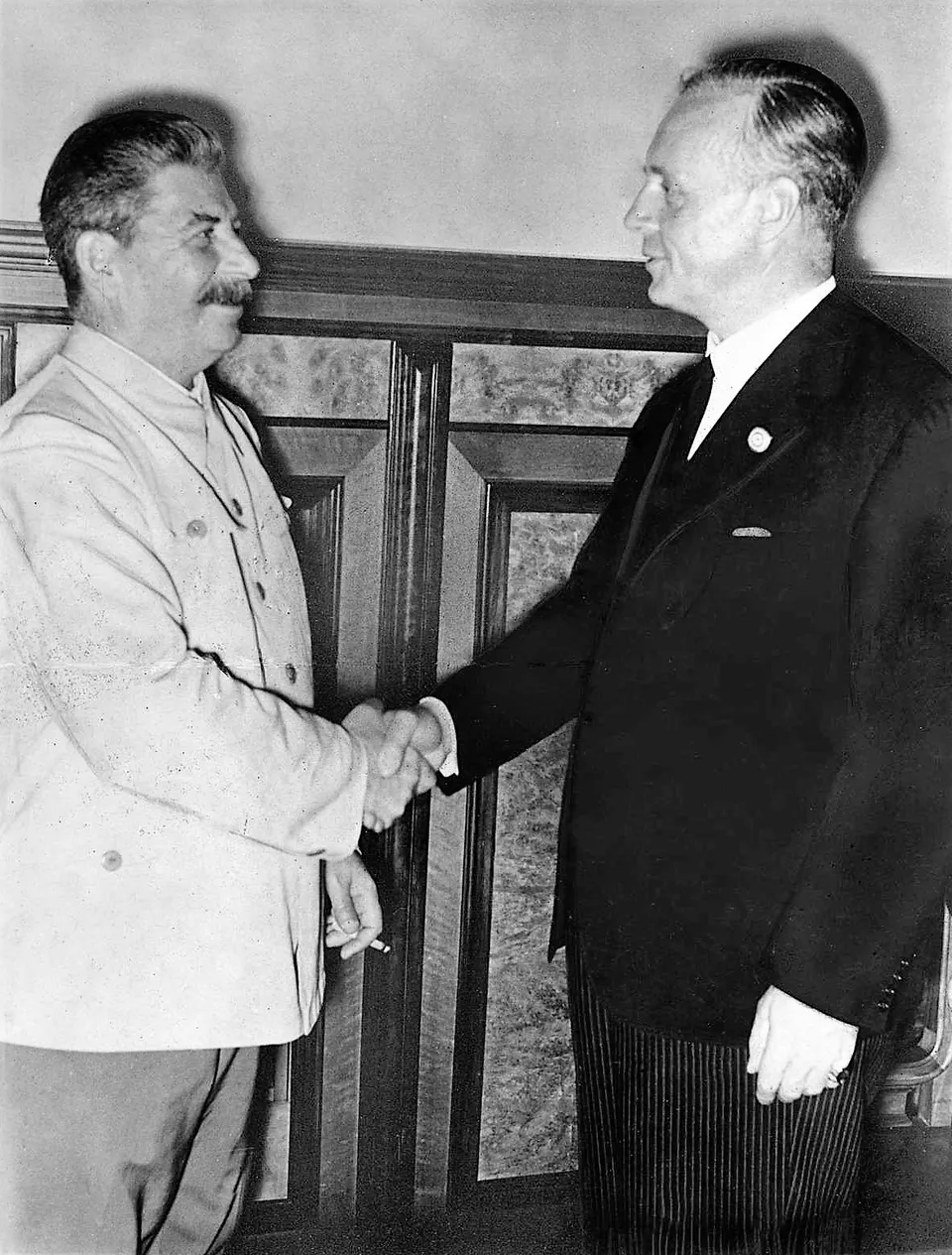
Stalin and Ribbentrop (right) talk in the Kremlin after signing the pact, 23 August 1939

Template:Helmut Laux · CC BY-SA 3.0 de · Source

After Munich the Soviet Union distrusted Britain and France, and the three-power military talks of summer 1939 made little headway. Hitler, preparing to invade Poland, wanted to avoid a war on two fronts. On 23 August German foreign minister Ribbentrop flew to Moscow and in the Kremlin signed a ten-year non-aggression pact with Soviet foreign commissar Molotov.

A secret protocol divided Poland between the two powers and assigned Finland, Estonia, Latvia and Romanian Bessarabia to the Soviet sphere. Germany invaded Poland on 1 September and the Soviet Union on the 17th, and in 1940 the USSR annexed the Baltic states and Bessarabia. Moscow denied the secret protocol existed until finally acknowledging it in 1989. The pact was broken by Germany’s invasion of the Soviet Union in June 1941.

The map in 1939

OpenFreeMap © OpenMapTiles © OpenStreetMap contributors

States and rulers at the time
Germany · signatory
Soviet Union · signatory — Leader Joseph Stalin
Poland · targeted
Places
Moscow Kremlin

People

  • Joachim von Ribbentrop1893 – 1946

    diplomat · Nazi Germany’s foreign minister (1938–1945) who concluded the Anti-Comintern Pact and the Nazi–Soviet Pact; executed after the Nuremberg trials

  • Vyacheslav Molotov1890 – 1986

    diplomat · Stalin’s close associate, Soviet premier (1930–1941) and foreign commissar, who signed the Nazi–Soviet Non-Aggression Pact in 1939

  • Joseph Stalin1878 – 1953

    leader · General Secretary of the Soviet Communist Party who ruled the USSR from the late 1920s until his death, led the war against Germany and drew Eastern Europe into the Soviet bloc

  • Adolf Hitler1889 – 1945

    leader · Nazi leader and Führer of Germany (1934–1945) who started the Second World War and perpetrated the Holocaust; he killed himself as Berlin fell

Before and after

Earlier
1938 Kristallnacht
Later
1941 The Holocaust

Themes that include this event

  • The Great Depression and Totalitarianism1919 – 1939

    From the Washington Conference to the invasion of Poland — two decades in which the age of international cooperation collapsed in the Depression, fascism, Nazism and Stalinism rose, and the world slid into war again