Conflict1467–1477

Ōnin War and the Warring States Period

Also called: Ōnin–Bunmei War, Sengoku period, Gekokujō

A succession dispute over the shogun Ashikaga Yoshimasa, entangled with feuds among powerful shugo houses, set off the Ōnin War in Kyoto, which lasted eleven years from 1467. The shogunate’s authority collapsed and the Warring States (Sengoku) period began, with rival daimyo fighting amid gekokujō — “the low overthrowing the high”.
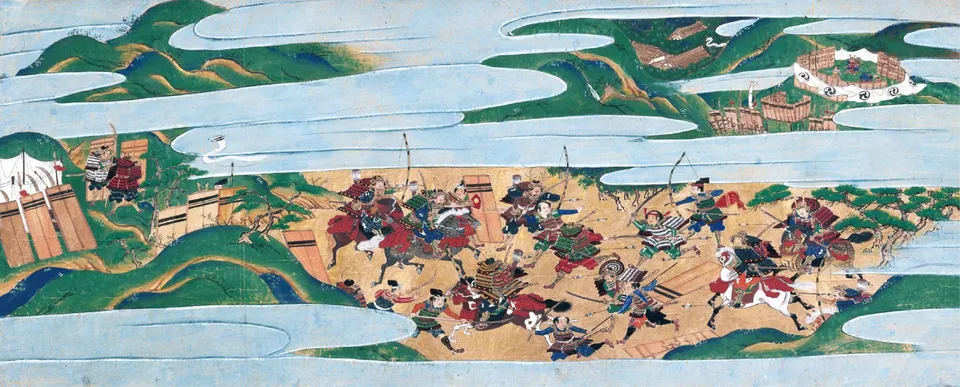
Ashigaru foot soldiers looting Kyoto during the Ōnin War, from the Shinnyodō engi scroll (16th century)

掃部助久国 Kamonnosuke Hisakuni · Public domain · Source

The court split between backers of the eighth shogun Yoshimasa’s brother Yoshimi and of his son Yoshihisa, and inheritance quarrels in the Hatakeyama and Shiba houses were added to the mix. The shogunate’s strongmen Hosokawa Katsumoto (Eastern Army) and Yamana Sōzen (Western Army) drew in daimyo from across the country, and fighting broke out in Kyoto in 1467; it dragged on until 1477 and left the city in ashes.

Afterwards the authority of the shogunate and the shugo daimyo collapsed, and amid gekokujō there arose Sengoku daimyo who ruled their domains directly and issued their own house laws. The Warring States period lasted until Oda Nobunaga and Toyotomi Hideyoshi unified the country in the late 16th century, and Hideyoshi then invaded Korea in 1592 (the Imjin War). Meanwhile western daimyo competed for trade with Joseon and the Ming, and in 1510 the Japanese residents of Joseon’s three ports rose in revolt.

The map in 1467

OpenFreeMap © OpenMapTiles © OpenStreetMap contributors

States at the time
Japan
Places
Heian-kyō

People

  • Ashikaga Yoshimasa1436 – 1490

    monarch · Eighth Muromachi shogun (r. 1449–1473), whose succession dispute grew into the Ōnin War; builder of the Silver Pavilion and patron of Higashiyama culture

Before and after

Themes that include this event

  • Song, Ming and Samurai JapanAD 960 – 1500

    The age when the civil-minded Song bought peace from Liao, Western Xia and Jin while the lower Yangtze boomed and Neo-Confucianism took shape, and the Ming, having driven out the Yuan, rebuilt the East Asian order through imperial autocracy, the sea ban and tribute — as Japan passed through the Kamakura and Muromachi warrior governments into the Warring States era, and Korea from Goryeo to Joseon

  • Ming, Qing and Edo Japan1500 – 1800

    The age when the Ming, shaken by northern raiders, southern pirates and the silver economy, fell to Li Zicheng’s rebels, and the Manchu Qing reached its greatest extent and prosperity under Kangxi, Yongzheng and Qianlong — as Japan was unified out of the Warring States into the Edo shogunate’s bakuhan order and closed country, and Joseon, after two great wars, met its neighbours through embassies to Edo and the Northern Learning