Muslim Maritime Trade and Silla
Also called: Book of Roads and Kingdoms, Dhow trade
In the Abbasid age Muslim merchants rode the monsoons from the Persian Gulf via India and Southeast Asia to Guangzhou in China. Ibn Khordadbeh recorded Silla beyond it.
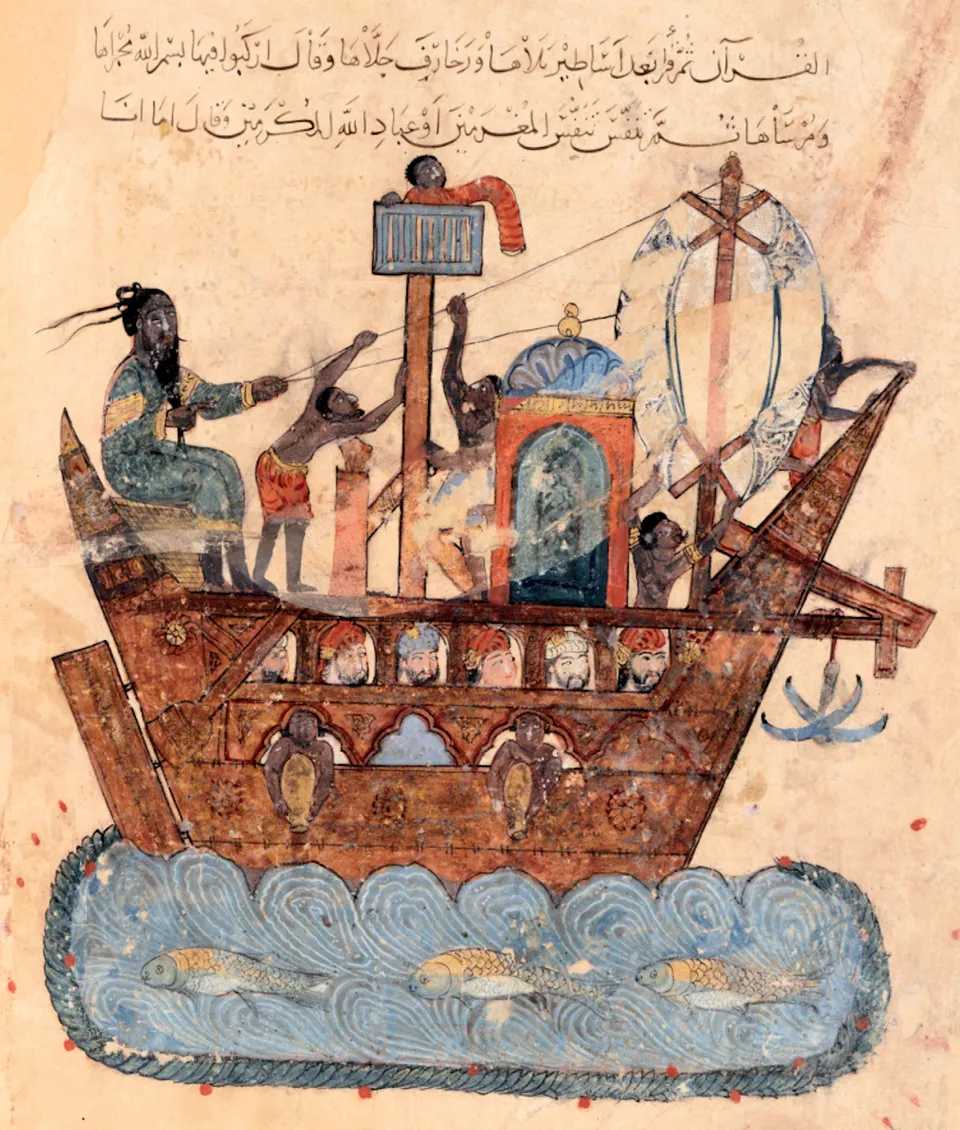
13th century artist · Public domain · Source
As Baghdad flourished, Arab and Persian Muslim merchants sailed lateen-rigged dhows on the monsoon winds from Basra and Siraf on the Persian Gulf, past India’s west coast and through the Strait of Malacca, to Tang Guangzhou (Canton). A foreign merchants’ quarter grew up in Guangzhou, and a 9th-century Arab-style wreck found off Belitung in Indonesia carried tens of thousands of pieces of Tang ceramics. Many foreign merchants in Guangzhou were killed during Huang Chao’s rebellion in 879, shaking the trade for a time.
Ibn Khordadbeh, an Abbasid official, described “al-Shila” (Silla) at the eastern end beyond China in his 9th-century Book of Roads and Kingdoms: gold was plentiful and the country so pleasant that Muslims who went there settled and never left. It is counted among the earliest records of Korea in West Asian writing, and later Arab geographers went on describing Silla.
In Silla, Jang Bogo’s Cheonghaejin controlled the sea lanes to Tang and Japan, and the stone warrior figures at the Gwaereung tomb (of King Wonseong) in Gyeongju are thought to depict Western or Central Asian men. Some scholars see Cheoyong, of the Samguk yusa legend, as a Muslim merchant who came to Silla. The Goryeosa records that in 1024, early in Goryeo, merchants from Dashi (Arabia) came and offered local products.