Founding of Baghdad
Also called: Round City of Baghdad, Madinat al-Salam
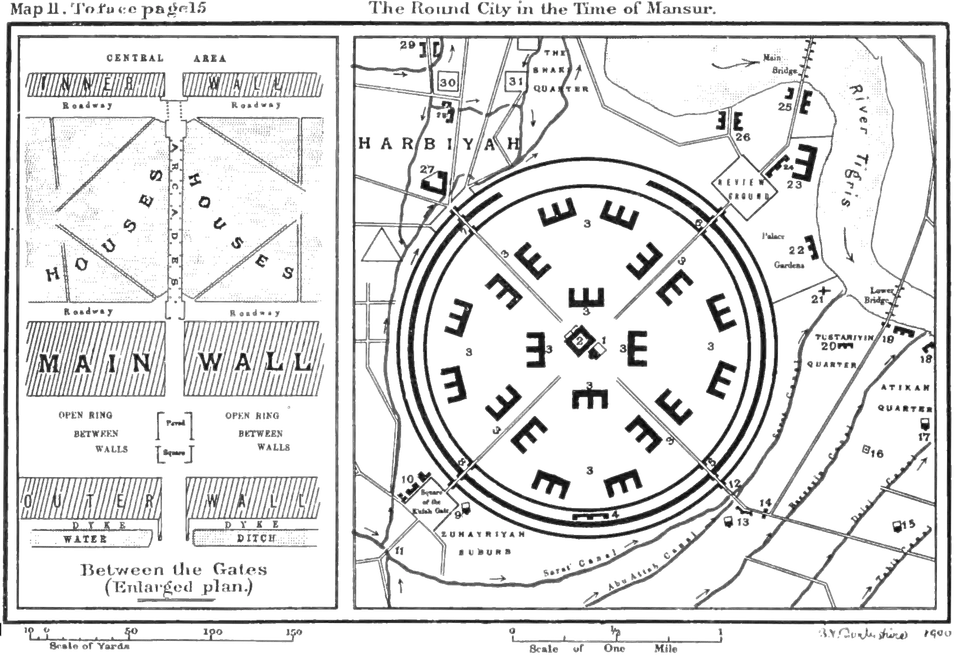
The Abbasid caliph al-Mansur founded a new capital, Baghdad, with circular walls on the Tigris. It became the centre of east–west trade and of Islamic culture.
Guy Le Strange (24 July 1854 – 24 December 1933) · Public domain · Source
Al-Mansur began building a new capital on the west bank of the Tigris in 762 and completed it within a few years. Officially called the City of Peace (Madinat al-Salam), it was a round city with concentric walls pierced by four gates and the palace and great mosque at its centre. The rivers and the Persian Gulf linked it by sea to India and China, and overland roads ran to Khurasan and the Silk Road.
Baghdad soon spread beyond its walls, and by the 9th century, with several hundred thousand people or more, it was among the largest cities in the world. Silk and porcelain from China, spices from India and gold and ivory from Africa gathered there. It flourished most under Harun al-Rashid (786–809) and became the setting of the Thousand and One Nights (Arabian Nights). Together with Tang Chang’an it ranks as one of the great cosmopolitan cities of the age.