Conflict10 May – 22 June 1940

Fall of France

Also called: Battle of France

German armour broke through the Ardennes and defeated France in six weeks; the British escaped by sea from Dunkirk and France signed an armistice.
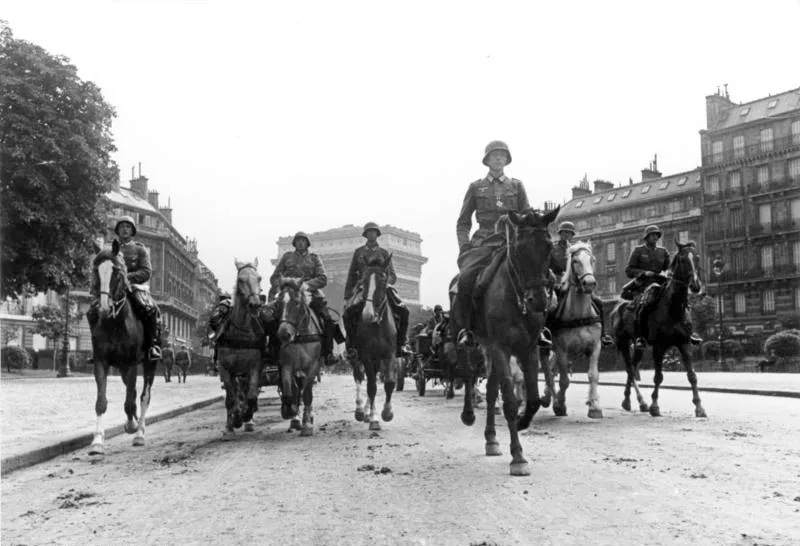
German troops parade in Paris, June 1940

Heinz Fremke · CC BY-SA 3.0 de · Source

On 10 May 1940 Germany opened its western offensive by attacking the Netherlands, Belgium and Luxembourg. Its main armoured force drove through the lightly defended Ardennes to the Channel, splitting the Allies in two. More than 300,000 British and French troops were evacuated from Dunkirk to Britain (26 May – 4 June).

German troops entered Paris on 14 June, and on 22 June France signed an armistice at Compiègne. The north was occupied by Germany and a collaborationist Vichy regime ruled the south. From London de Gaulle called for resistance and led Free France.

The map in 1940

OpenFreeMap © OpenMapTiles © OpenStreetMap contributors

States at the time
Germany · invader
France · defeated
Great Britain · intervened
Places
Paris

People

  • Adolf Hitler1889 – 1945

    leader · Nazi leader and Führer of Germany (1934–1945) who started the Second World War and perpetrated the Holocaust; he killed himself as Berlin fell

  • Charles de Gaulle1890 – 1970

    related figure · French general who refused the 1940 surrender and led Free France from London; later president of the Fifth Republic (1959–1969)

Before and after

Related works

  • Film: Darkest HourDramatizedFilm · 2017 · Joe Wright
  • Film: DunkirkDramatizedFilm · 2017 · Christopher Nolan

Dramatized works (films, dramas, novels) may differ from the historical record.

Themes that include this event

  • World War II1939 – 1945

    From the invasion of Poland to the surrender of Japan — the largest war in human history, across Europe, Asia and the Pacific