Philosophy399 BC (death of Socrates) – 322 BC (death of Aristotle)

The Death of Socrates and Greek Philosophy

In 399 BC an Athenian court sentenced Socrates to death for corrupting the young. His disciple Plato and Plato’s pupil Aristotle built the framework of Western philosophy.
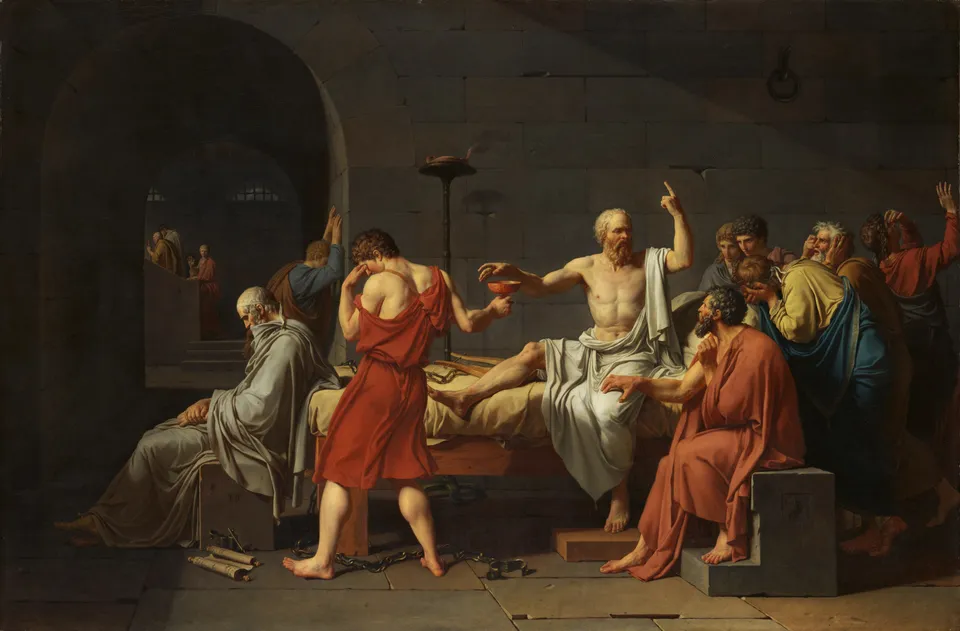
The Death of Socrates — Socrates speaks to his disciples of the soul’s immortality as he takes the hemlock; Jacques-Louis David, 1787

Jacques-Louis David · Public domain · Source

Greek philosophy, which had asked what nature was made of, turned in democratic Athens to man and society. Sophists such as Protagoras, holding that “man is the measure of all things” and that truth differs from person to person, taught the art of persuasion (rhetoric). Socrates opposed them, using dialogue to lead others to recognise their own ignorance and seeking universal truth and virtue.

In the turmoil after Athens lost the Peloponnesian War, Socrates was charged with not believing in the city’s gods and corrupting the young, and in 399 BC he died by drinking hemlock. His disciple Plato founded the Academy, explored the Forms as true reality and argued for rule by philosopher-kings. Plato’s pupil Aristotle, who observed the real world and systematised logic, ethics, politics and natural science, was also Alexander’s tutor.

The map in 399 BC

OpenFreeMap © OpenMapTiles © OpenStreetMap contributors

States at the time
Greek city-states
Places
Athens

People

  • Socrates470 BC – 399 BC

    leader · Athenian philosopher who sought universal truth by questioning others into recognising their ignorance, and was executed for corrupting the young

  • Plato427 BC – 347 BC

    author · Disciple of Socrates who founded the Academy in Athens and wrote dialogues such as the Republic, setting out the theory of Forms and rule by philosopher-kings

  • Aristotle384 BC – 322 BC

    author · Pupil of Plato and tutor of Alexander who founded the Lyceum and systematised logic, ethics, politics and natural science

Before and after

Earlier
431 BC Peloponnesian War

Themes that include this event

  • Greece and Rome2000 BC – AD 476

    From the Aegean civilisation to the fall of the Western Roman Empire — the classical civilisation built by the democracy of the polis and the Roman republic and empire