Culture751

Building of Bulguksa and Seokguram

Kim Dae-seong, chief minister under King Gyeongdeok, began Bulguksa and the Seokguram grotto on Mount Toham — the summit of unified Silla’s Buddhist art.
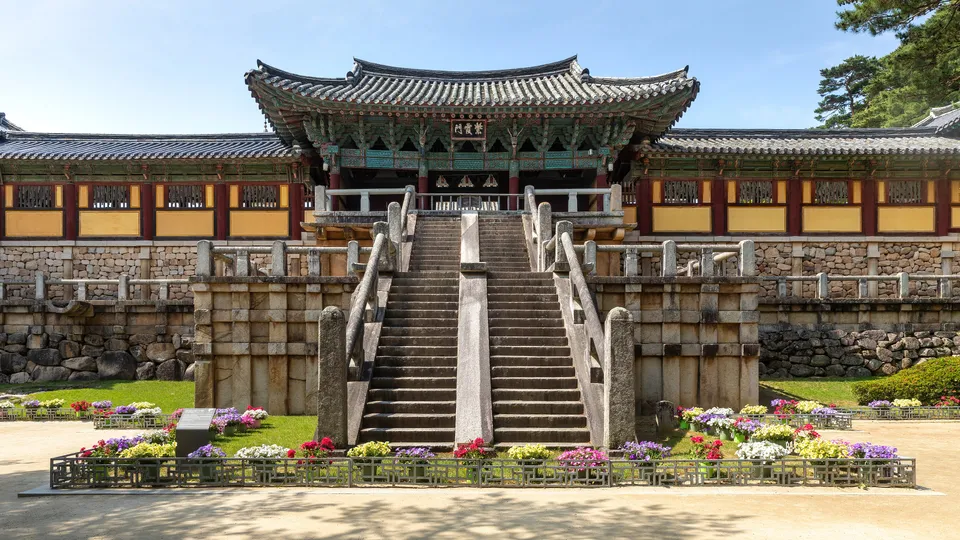
Cheongungyo and Baegungyo stone stairways of Bulguksa, begun by Kim Dae-seong in 751, Gyeongju

Basile Morin · CC BY-SA 4.0 · Source

The Samguk yusa says Kim Dae-seong built Bulguksa for his parents in this life and Seokguram for his parents in a former life; the state completed them after his death in 774. Bulguksa was meant to make the Buddha Land visible on earth, with the Seokgatap and Dabotap pagodas and the Cheongungyo and Baegungyo stairways.

In 1966 repairs to the Seokgatap revealed the Mugujeonggwang Great Dharani Sutra, printed before about 751 and regarded as the oldest surviving woodblock print in the world. Seokguram is an artificial grotto of fitted granite, its domed chamber holding a seated Buddha ringed by bodhisattvas and disciples. Both became World Heritage in 1995.

The map in AD 751

OpenFreeMap © OpenMapTiles © OpenStreetMap contributors

States and rulers at the time
Silla — King Gyeongdeok
Places
Bulguksa Temple, Gyeongju, Seokguram Grotto, Gyeongju

People

  • Kim Dae-seongAD 774

    leader · Chief minister under King Gyeongdeok who, according to the Samguk yusa, began Bulguksa and Seokguram

  • King GyeongdeokAD 765

    monarch · 35th king of Silla, who sinicized official titles and place names but restored the nogeup stipend villages; Bulguksa and Seokguram were begun in his reign

Before and after

Themes that include this event

  • Changes in PagodasAD 634 – 1467

    From Baekje stone pagodas copying timber ones and Silla pagodas copying brick ones, to Unified Silla three-story pagodas and stupas, Goryeo multi-sided pagodas and Yuan-influenced marble towers

  • Changes in Buddhist StatuesAD 539 – 1100

    From a Goguryeo gilt-bronze Buddha in Northern Wei style and "the smile of Baekje" to the Seokguram Buddha, Balhae’s twin Buddhas, early Goryeo iron Buddhas and colossal regional stone figures

  • Intangible and World Heritage2000 BC – 1850

    From the dolmens to Namhansanseong on the World Heritage List, from Jongmyo ritual music to ssireum on the Intangible Heritage lists — where each came from and when it was inscribed

  • Gyeongju57 BC – 1860

    Silla’s capital for a thousand years — tombs, pagodas, temples and bells from every age of Silla, and the birthplace of Donghak