Berlin Conference and the Partition of Africa
Also called: Congo Conference, Scramble for Africa
The powers met in Berlin to set the rules for dividing Africa. Within thirty years all of Africa except Ethiopia and Liberia had become European colonies.
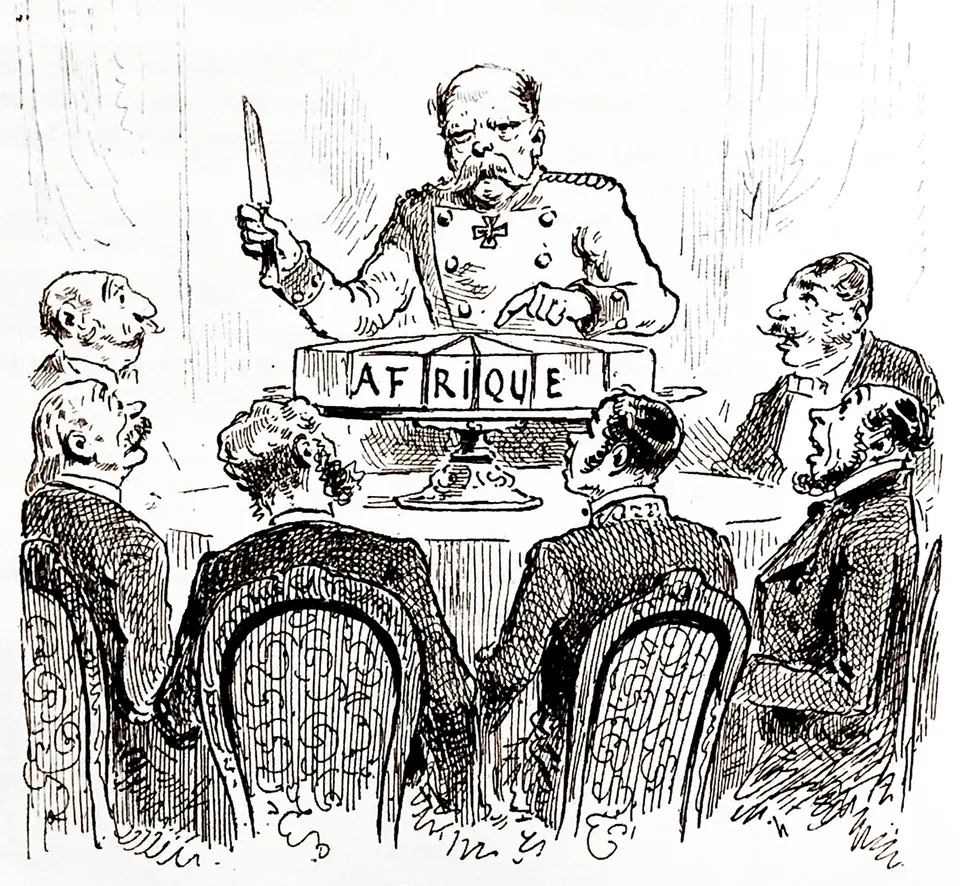
Until the mid-nineteenth century Europe held only coastal footholds in Africa, but the explorations of Livingstone and Stanley opened the interior, and when King Leopold II of Belgium sought the Congo basin, rivalry among the powers intensified. From 15 November 1884 to 26 February 1885 Bismarck hosted representatives of fourteen states, the European powers and the United States among them, in Berlin. Not a single African was invited.
The conference declared free navigation on the Congo and Niger rivers and free trade in the Congo basin, and recognized Leopold II’s Congo Free State. It also laid down the principle of "effective occupation": a power claiming new coastline had to notify the others and actually control it. This set off the "Scramble for Africa", as the powers raced to occupy the interior.
Britain pursued a north–south line from Cairo to the Cape, France an east–west line from Algeria and the Sahara to Madagascar, and Germany, Italy, Portugal and Belgium joined in. Borders were drawn as straight lines on maps regardless of peoples and ethnic boundaries, sowing the seeds of conflict after independence. In the Congo Free State the extraction of rubber killed vast numbers of people, provoking international outrage, and the Belgian state took the colony over in 1908.