Battle of Talas
Also called: Battle of Talas River, Battle of Artlakh
On the Talas River in Central Asia a Tang army led by Gao Xianzhi, a general of Goguryeo descent, was heavily defeated by the Abbasids. Chinese papermakers taken prisoner are said to have brought papermaking to the Islamic world.
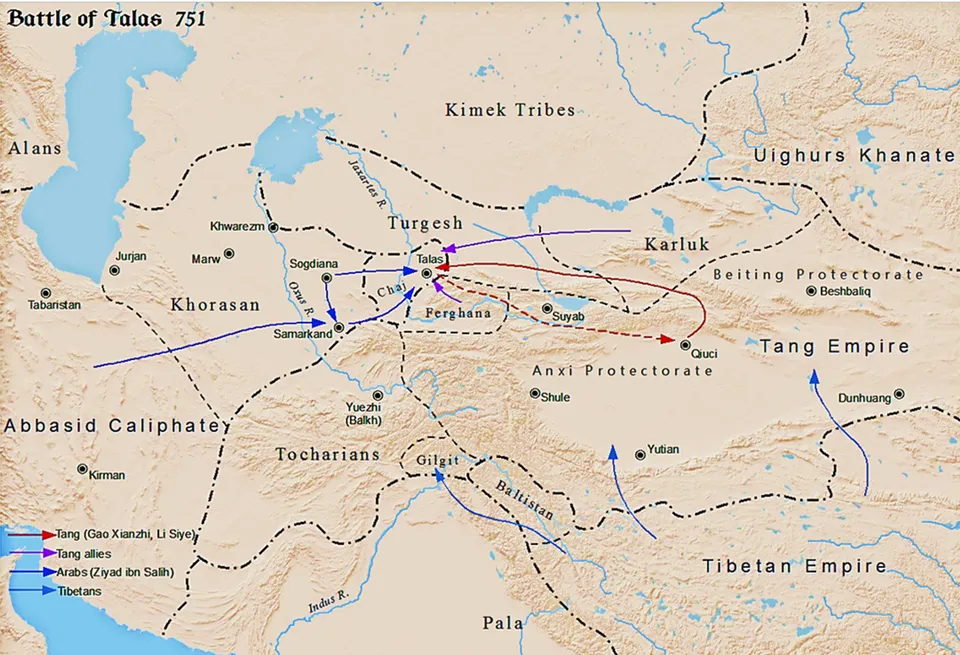
SY · CC BY-SA 4.0 · Source
Through its Anxi Protectorate, Tang China extended its influence to the oasis states west of the Pamirs. Gao Xianzhi, a general descended from Goguryeo refugees, made his name in 747 by leading an army across the Pamirs to subdue Little Balur (Gilgit), which had been about to join the Tibetans. When in 750 he attacked Chach (Tashkent), carried its king off to Chang’an and had him executed, the king’s son appealed to neighbouring states and to the Abbasids.
Around July 751 Gao’s Tang army met an Abbasid force under Ziyad ibn Salih on the Talas River. When the Turkic Karluk troops on the Tang side changed sides mid-battle, the Tang army was routed, and Gao returned with only a small remnant. After the An Lushan Rebellion broke out in 755 and the Tang withdrew its armies from the west, Central Asia passed into the Islamic world, and its Islamisation and Turkicisation followed.
According to Muslim sources, among the Tang prisoners were papermakers who began making paper at Samarkand. By the late 8th century there was a paper mill in Baghdad too, sustaining the flowering of Islamic learning, and paper later reached Europe. Some scholars argue, however, that papermaking was already known in Central Asia before the battle. Du Huan, one of the prisoners, returned home and wrote the Jingxingji, an account of what he saw of the Islamic world.