Politics13 July 1793

Assassination of Marat

Also called: Death of Marat

Charlotte Corday, a Girondin sympathiser, stabbed Marat in his bath; David’s The Death of Marat made him a martyr of the Revolution.
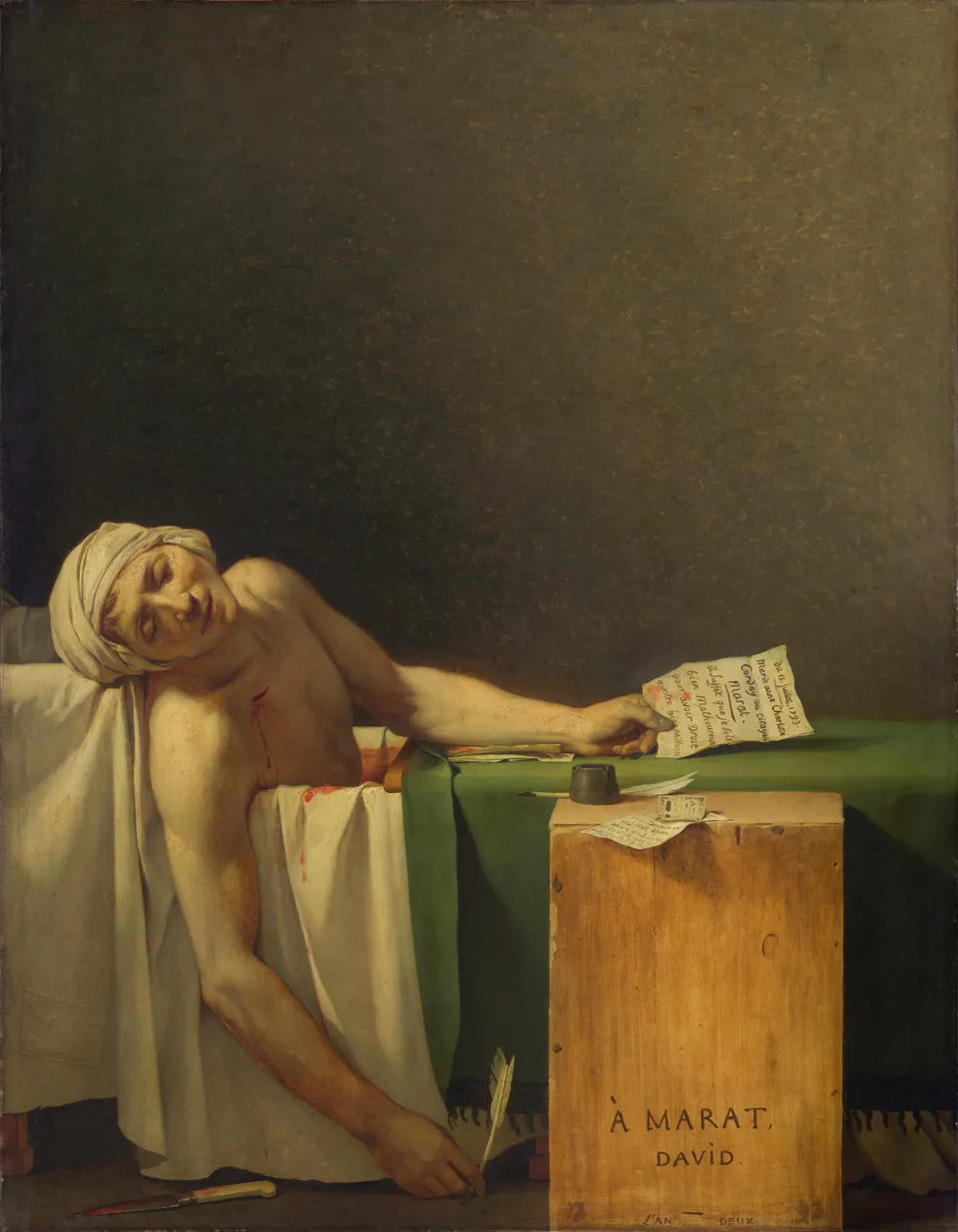
The Death of Marat — Jacques-Louis David, 1793, Royal Museums of Fine Arts of Belgium, Brussels

Jacques-Louis David · Public domain · Source

Working from a medicinal bath because of a skin disease, Marat, whose paper L’Ami du peuple had called for the purge of the Girondins, was a symbol of the radicals. After the Girondin deputies were expelled in June 1793, Charlotte Corday, a 25-year-old supporter of theirs in Caen, Normandy, travelled to Paris. On the evening of 13 July she gained entry to Marat’s home by promising to name traitors and stabbed him to death in his bath.

Seized on the spot, Corday was guillotined on 17 July. The Montagnards honoured Marat as a martyr of the Revolution, and David staged his funeral and painted The Death of Marat for the Convention. The killing only hardened the repression of the Girondins and the Terror.

The map in 1793

OpenFreeMap © OpenMapTiles © OpenStreetMap contributors

States at the time
France
Places
Paris

People

  • Jean-Paul Marat1743 – 1793

    related figure · Physician turned journalist and Convention deputy whose paper L’Ami du peuple urged radical revolution; assassinated by Charlotte Corday in 1793

  • Charlotte Corday1768 – 1793

    key figure · Norman supporter of the Girondins who stabbed Marat to death in Paris on 13 July 1793 and was guillotined four days later

  • Jacques-Louis David1748 – 1825

    related figure · Neoclassical painter and Convention deputy who painted The Tennis Court Oath and The Death of Marat, staged the revolutionary festivals and later became Napoleon’s court painter

Before and after

Earlier
1793 War in the Vendée

Themes that include this event

  • The French Revolution1787 – 1799

    From the Assembly of Notables and the Estates-General to the coup of 18 Brumaire — twelve years that toppled the absolute monarchy, founded a republic, passed through Terror and reaction, and ended with Napoleon