Politics27–28 July 1794

Thermidorian Reaction

Also called: 9 Thermidor, Fall of Robespierre

Fearing they would be next, deputies had Robespierre arrested and executed; the Terror ended and the Revolution turned in a moderate direction.
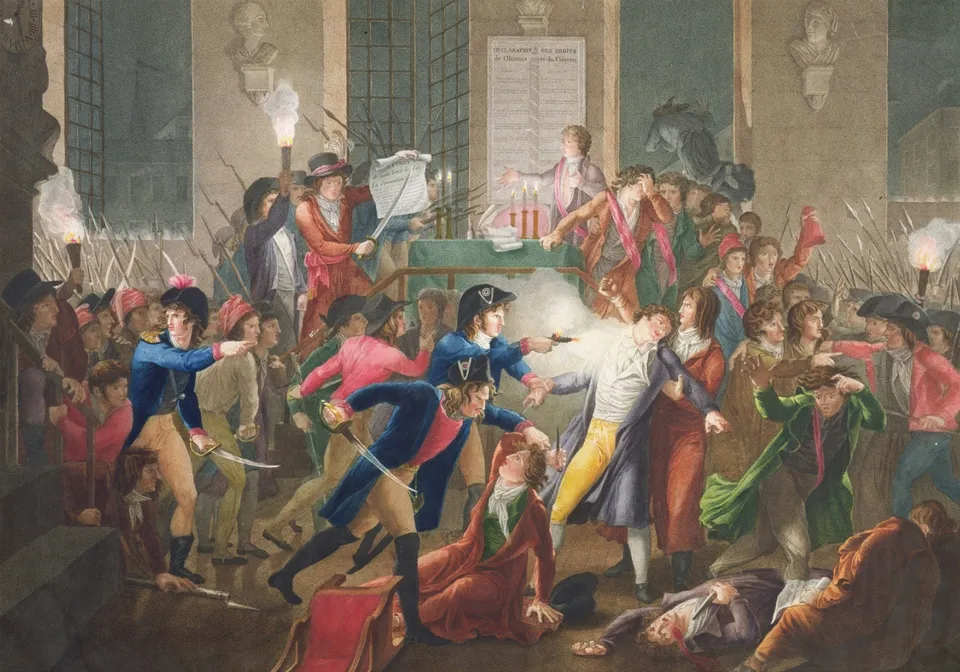
The arrest of Robespierre at the Hôtel de Ville on the night of 9 Thermidor — engraving by Jean-Joseph-François Tassaert after Fulchran-Jean Harriet, c. 1796

After Fulchran-Jean Harriet · Public domain · Source

Even after the victory at Fleurus in June 1794 eased the foreign threat, the executions kept rising. When Robespierre told the Convention on 26 July that he would purge unnamed “traitors”, frightened deputies joined forces. The next day, 27 July (9 Thermidor Year II), the Convention voted to arrest Robespierre, Saint-Just and others.

The Paris Commune freed them and took them to the Hôtel de Ville, but few people rallied, and that night Convention troops under Barras burst in. Wounded in the jaw by a gunshot, Robespierre was guillotined with 21 associates on 28 July. The Jacobin Club was then closed, suspects were released, and in the “White Terror” the Jacobins themselves faced reprisals.

The map in 1794

OpenFreeMap © OpenMapTiles © OpenStreetMap contributors

States at the time
France
Places
Hôtel de Ville, Paris, Tuileries Palace, Place de la Concorde

People

  • Maximilien Robespierre1758 – 1794

    related figure · Jacobin leader who dominated the Committee of Public Safety during the Reign of Terror and was guillotined after the Thermidorian Reaction of 1794

  • Paul Barras1755 – 1829

    key figure · Convention deputy who led the Thermidorian Reaction and became the strongman of the Directory until the coup of Brumaire

Before and after

Later
1795 The Directory

Themes that include this event

  • The French Revolution1787 – 1799

    From the Assembly of Notables and the Estates-General to the coup of 18 Brumaire — twelve years that toppled the absolute monarchy, founded a republic, passed through Terror and reaction, and ended with Napoleon