The Punishment of Loki
Also called: Loki bound, Loki and Sigyn, Lokasenna, Binding of Loki
A legend handed down over the centuries.
A Norse myth told in the prose ending of the Eddic poem Lokasenna (Loki’s Flyting) and in Snorri’s Prose Edda. Loki, who caused Baldr’s death, hid as a salmon, was caught and bound to rocks with his son’s entrails, while his wife Sigyn catches in a bowl the venom dripping from a serpent above him.
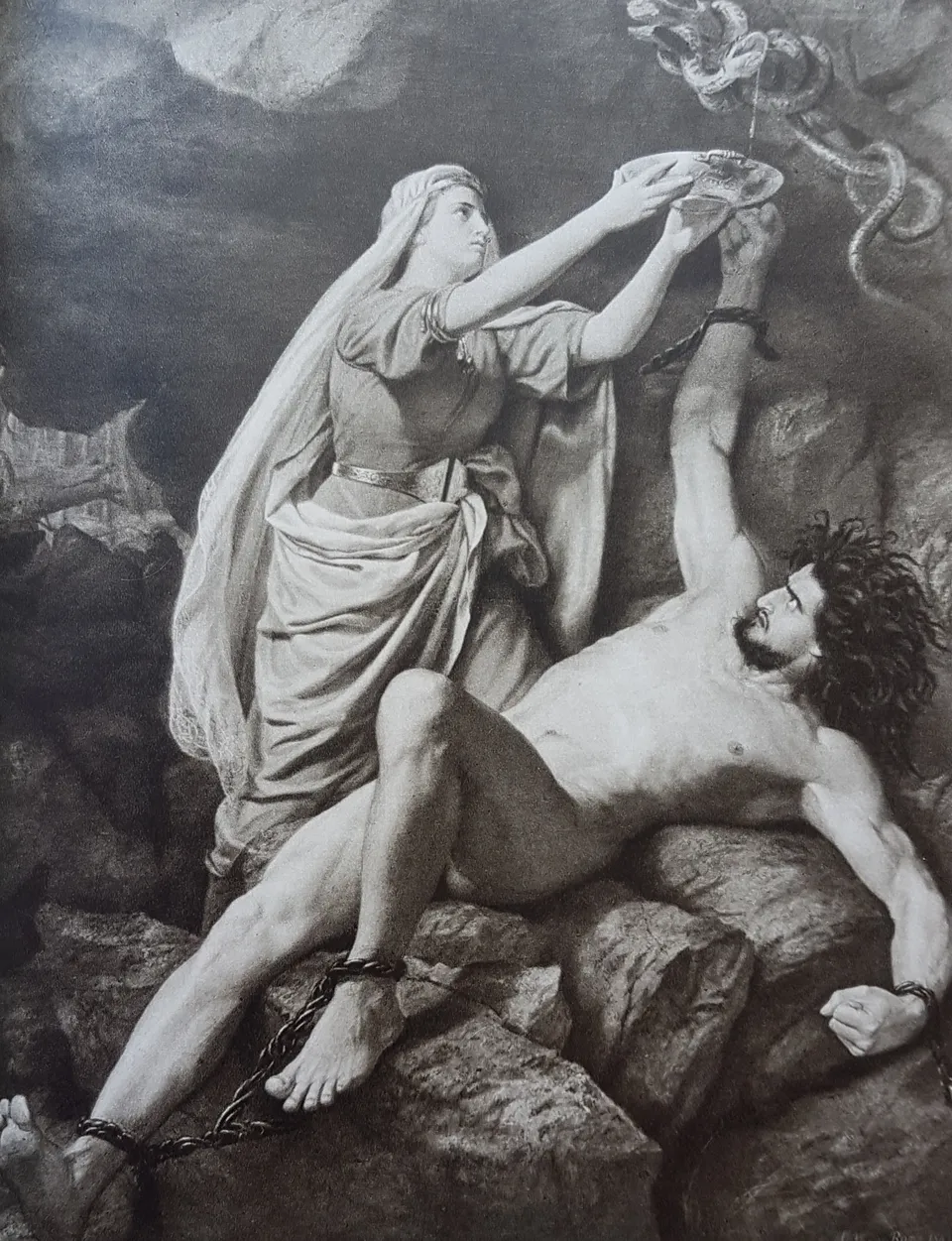
Mårten Eskil Winge · Public domain · Source
This Norse myth is told in the prose passage at the end of Lokasenna in the Poetic Edda and in Gylfaginning of Snorri Sturluson’s Prose Edda. In Lokasenna, Loki forces his way into the feast of the sea giant Ægir and insults the gods one by one; in Snorri, he flees the gods’ wrath after Baldr’s death.
Loki hid in a house in the mountains and then, as a salmon, beneath a waterfall. The gods wove a net modelled on one Loki himself had invented, and when the salmon leapt over it Thor caught it by the tail (which is why the salmon’s tail is thin, it is said). The gods turned Loki’s son Váli into a wolf, which tore apart his brother Narfi, and with Narfi’s entrails bound Loki across three rocks. The giantess Skaði hung a venomous serpent above him so that its poison would drip onto his face.
His wife Sigyn stands by, catching the venom in a bowl; but when the bowl is full and she goes to empty it, the venom falls on Loki and he writhes so that the earth shakes — and that, it is said, is an earthquake. There he lies bound until Ragnarök. The 10th-century Gosforth Cross in England bears a scene that seems to show a bound figure and a woman with a bowl.