Westernisation under Peter the Great
Also called: Petrine reforms, Great Northern War, Founding of Saint Petersburg, Battle of Poltava
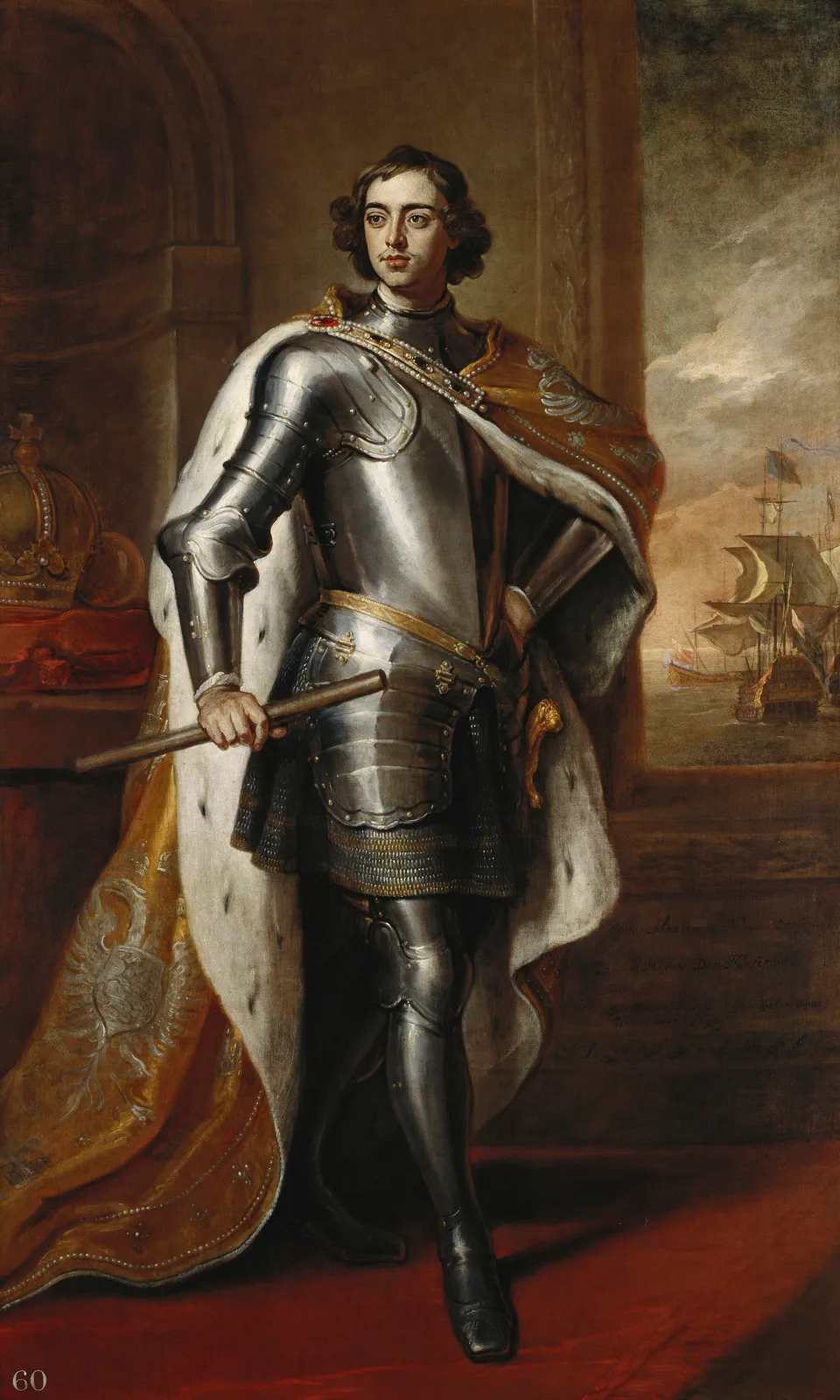
Peter the Great of Russia learned Western techniques on his Grand Embassy (1697–1698) and remade the army, administration and customs on Western lines; defeating Sweden in the Great Northern War, he reached the Baltic and made Saint Petersburg (founded 1703) his new capital.
Godfrey Kneller · Public domain · Source
Tsar at the age of ten, Peter in 1697–1698 led a Grand Embassy of some 250 people around Western Europe, learning shipbuilding with his own hands in Dutch and English shipyards. Back home he had the nobles’ beards shaved, introduced Western dress and the Western calendar, created a standing army and a navy, and opened schools and factories. Through the Senate and the Table of Ranks (1722) he promoted officials by merit, and he abolished the patriarchate to place the Church under the state.
To win a sea outlet on the Baltic he fought Sweden in the Great Northern War (1700–1721): beaten at Narva, he crushed Charles XII at Poltava (1709). In May 1703, in the midst of the war, he founded Saint Petersburg at the mouth of the Neva as a “window on Europe” and moved the capital there in 1712. The Treaty of Nystad (1721) gave him the Baltic coast, and he took the title of emperor.
The reforms were imposed from above and serfdom grew heavier, but Russia rose to the rank of a European great power. Earlier, Russians pushing east across Siberia had reached the Amur and clashed with the Qing, and at Qing request Joseon sent musketeers on the Naseon expeditions (1654 and 1658); in 1689 Russia and the Qing fixed their border by the Treaty of Nerchinsk.