Conflict6 June 1944

Normandy Landings

Also called: D-Day, Operation Overlord

Allied forces under Eisenhower landed on the coast of Normandy, opening a western front; Paris was liberated in August.
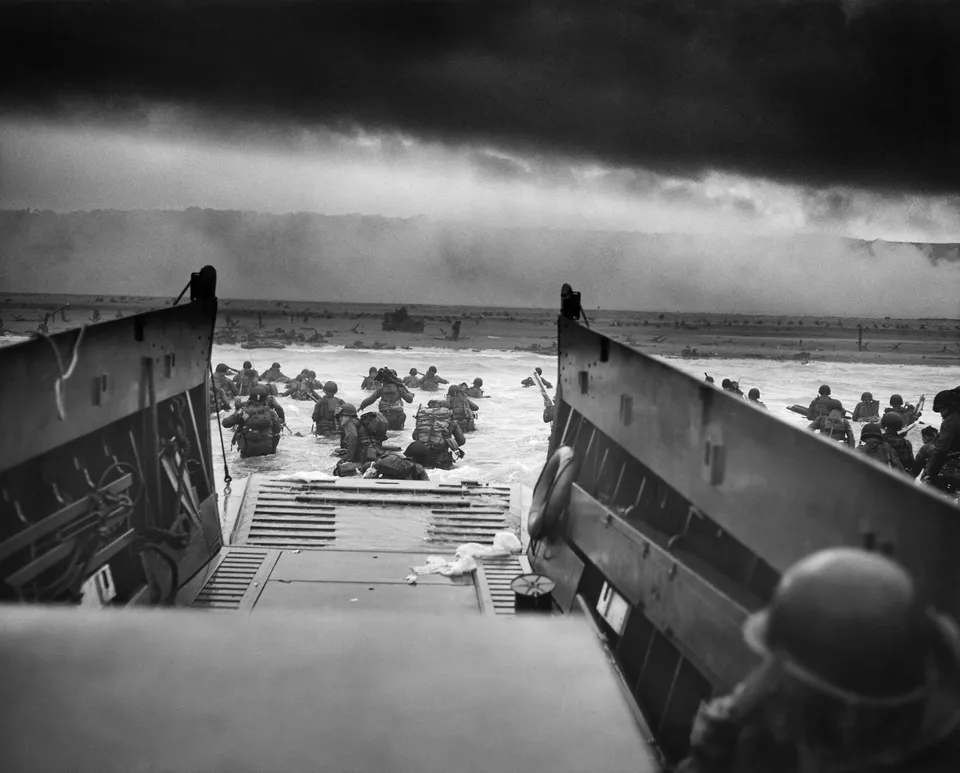
“Into the Jaws of Death” — troops of the US 1st Infantry Division wade ashore on Omaha Beach, 6 June 1944 (Robert F. Sargent)

Chief Photographer's Mate (CPHoM) Robert F. Sargent · Public domain · Source

The Soviet Union had long demanded a second front in western Europe. On 6 June 1944 (D-Day) more than 150,000 American, British, Canadian and other Allied troops, backed by thousands of ships and aircraft, came ashore on five Normandy beaches (Utah, Omaha, Gold, Juno and Sword), while airborne troops dropped inland overnight. Losses were heaviest on Omaha Beach.

Having widened the beachhead, the Allies broke through the German lines in late July, and Paris was liberated on 25 August. Squeezed between the Soviets in the east and the Allies in the west, Germany collapsed the following spring.

The map in 1944

OpenFreeMap © OpenMapTiles © OpenStreetMap contributors

States and rulers at the time
United States · Allies — President Franklin D. Roosevelt
Great Britain · Allies
Canada · Allies
Germany · defeated
Places
Omaha Beach

People

  • Dwight D. Eisenhower1890 – 1969

    commander · Supreme Allied Commander who directed the Normandy landings; later 34th US president (1953–1961), who brought about the Korean armistice

  • Bernard Montgomery1887 – 1976

    commander · British general who defeated Rommel at the Second Battle of El Alamein and commanded the ground forces in the Normandy landings

  • Erwin Rommel1891 – 1944

    related figure · German field marshal, “the Desert Fox”, who led the Afrika Korps; implicated in the plot against Hitler, he was forced to take his own life

Before and after

Earlier
1943 Battle of Kursk

Related works

Dramatized works (films, dramas, novels) may differ from the historical record.

Themes that include this event

  • World War II1939 – 1945

    From the invasion of Poland to the surrender of Japan — the largest war in human history, across Europe, Asia and the Pacific