The Judgement of Paris
Also called: Judgment of Paris
A legend handed down over the centuries.
A Greek myth told in the Cypria and briefly mentioned in Book 24 of the Iliad. On Mount Ida the Trojan prince Paris had to choose the most beautiful of three goddesses, and chose Aphrodite, who promised him the most beautiful woman in the world.
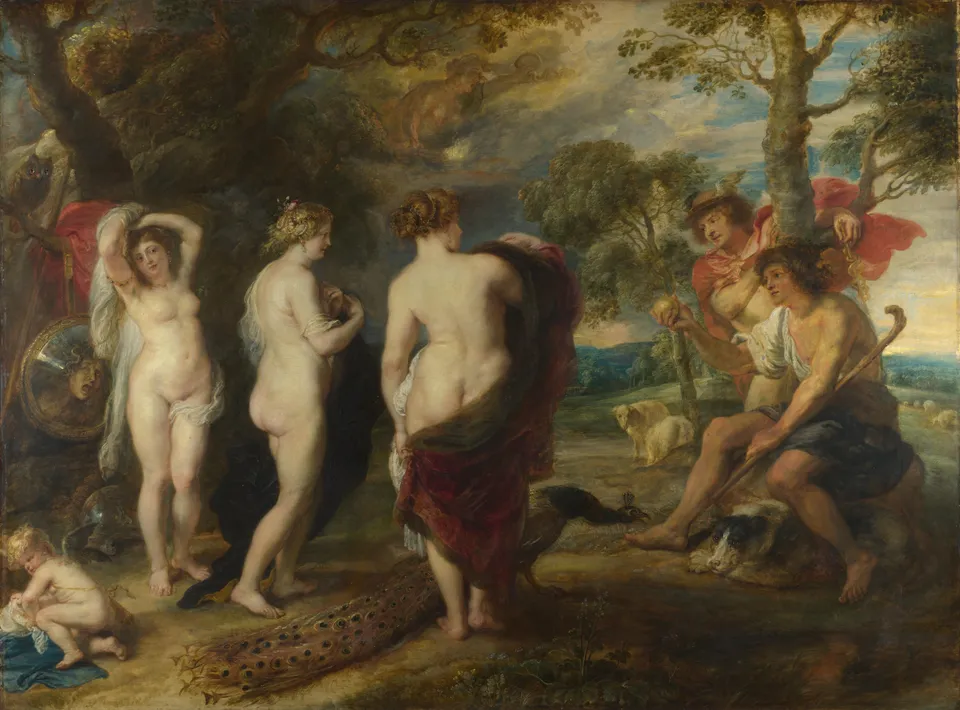
Peter Paul Rubens · Public domain · Source
This Greek myth is told in the Cypria (known from a summary), and Homer’s Iliad (Book 24) briefly says that Paris insulted the goddesses. Zeus sent the three goddesses quarrelling over the golden apple with Hermes to Paris (also called Alexandros), a Trojan prince tending flocks on Mount Ida near Troy. According to Apollodorus, Paris had been exposed as a baby because his mother Hecuba dreamed she gave birth to a firebrand that burned Troy, and he grew up among herdsmen.
Hera offered him rule over Asia, Athena victory in war and wisdom, and Aphrodite the most beautiful woman in the world. When Paris gave the apple to Aphrodite, Hera and Athena sided with the Greeks throughout the Trojan War. The scene has been a favourite of Western art from ancient vases to paintings by Rubens and Cranach.