Discovery of the Hunminjeongeum Haerye
Also called: Hunminjeongeum Haerye
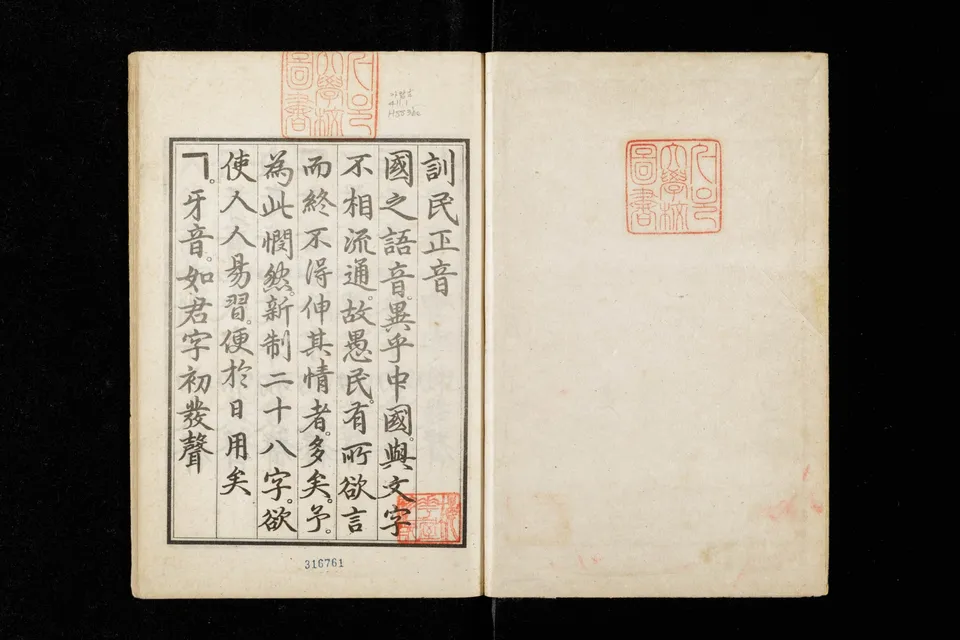
The Haerye edition of the Hunminjeongeum, published in 1446, came to light in Andong, revealing for the first time the principles behind the Korean alphabet.
Government of Joseon · Public domain · Source
The Hunminjeongeum Haerye is the explanatory edition published in 1446 when King Sejong promulgated the new script. It contains Sejong’s preface and the "Examples" setting out the sounds of the letters, the "Explanations" (on the design of the letters, the initial sounds and so on) by Jeong In-ji, Seong Sam-mun and other scholars of the Hall of Worthies, and Jeong In-ji’s postface. Long thought lost, a copy surfaced in Andong, North Gyeongsang, in 1940, and Jeon Hyeong-pil (Gansong) bought it at great cost and protected it.
The Haerye made it clear that the consonants were modelled on the shape of the speech organs and the vowels on heaven, earth and man; before that there had been many guesses, such as lattice-window patterns or older scripts. It is a National Treasure held at the Kansong Art Museum, and became UNESCO Memory of the World in 1997.