CultureSeptember 1446(Lunar)

Promulgation of Hunminjeongeum

Also called: Creation of Hangul

King Sejong published Hunminjeongeum, a new script he created for ordinary people.
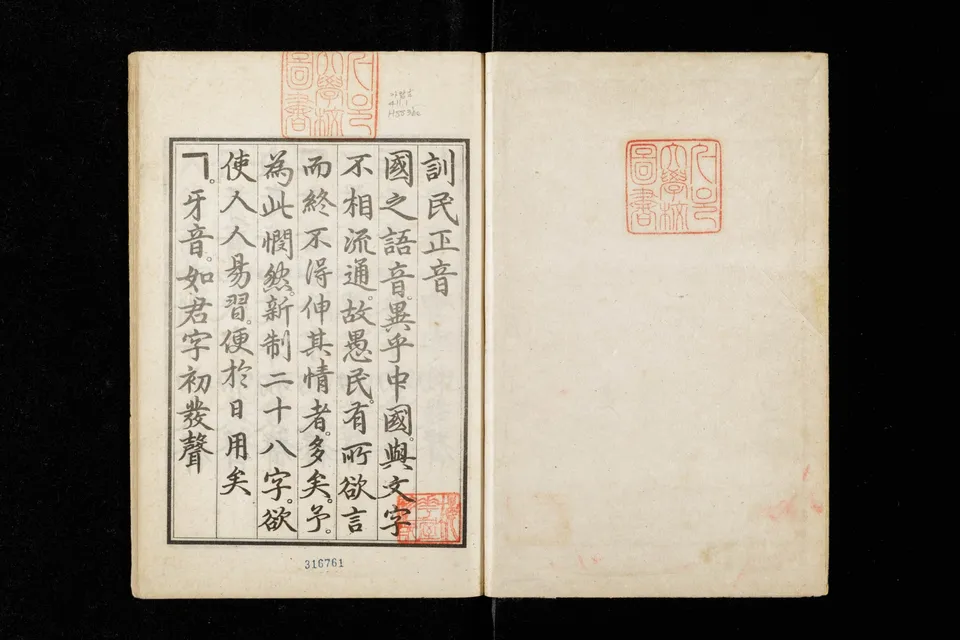
Opening page of the Hunminjeongeum Haerye, 1446 (facsimile)

Government of Joseon · Public domain · Source

Sejong created the 28 letters of Hunminjeongeum in the twelfth month of 1443 and promulgated them in the ninth month of 1446 with an explanatory volume, the Haerye edition. Its preface explains that "the speech of our country differs from that of China and does not fit Chinese characters", so the king made letters that ordinary people could easily learn and use every day. The commentary was written by Hall of Worthies scholars including Jeong In-ji, Seong Sam-mun and Sin Suk-ju.

The basic consonants ㄱ, ㄴ, ㅁ, ㅅ and ㅇ mirror the shape of the speech organs, with strokes added for related sounds; the vowels represent heaven (·), earth (ㅡ) and humankind (ㅣ). In 1444 Choe Man-ri and others memorialised against it as a breach of loyalty to China.

Sejong had the Songs of the Dragons Flying to Heaven, the Seokbo sangjeol and the Worin cheongang jigok published in the new script, and added it to the examinations for lower clerks. The Haerye edition was inscribed on UNESCO’s Memory of the World Register in 1997. It is today’s Hangul.

The map in 1446

OpenFreeMap © OpenMapTiles © OpenStreetMap contributors

States and rulers at the time
Joseon — Sejong

People

  • Sejong the Great1397 – 1450

    creator · Fourth king of Joseon, creator of Hangul, patron of science and of the northern frontier

  • Jeong In-ji1396 – 1478

    author · Jiphyeonjeon scholar who wrote the preface to the Hunminjeongeum haerye and led the compilation of the Goryeosa

  • Seong Sam-mun1418 – 1456

    participant · Hall of Worthies scholar executed for plotting to restore Danjong; one of the Six Martyred Ministers

  • Sin Suk-ju1417 – 1475

    participant · Jiphyeonjeon scholar who helped create Hunminjeongeum, wrote the Haedong jegukgi after a mission to Japan, and became Chief State Councillor under Sejo

Before and after

Related works

Dramatized works (films, dramas, novels) may differ from the historical record.

Themes that include this event

  • Printing and Documentary HeritageAD 751 – 2011

    From the Dharani Sutra to the May 18 archives — woodblock and metal-type printing, and the records inscribed on the Memory of the World