Hellenistic Culture
Also called: Hellenistic Age
After Alexander’s empire broke apart, a Hellenistic culture blending Greek and Near Eastern traditions flourished, centred on Alexandria in Egypt; the natural sciences advanced especially.
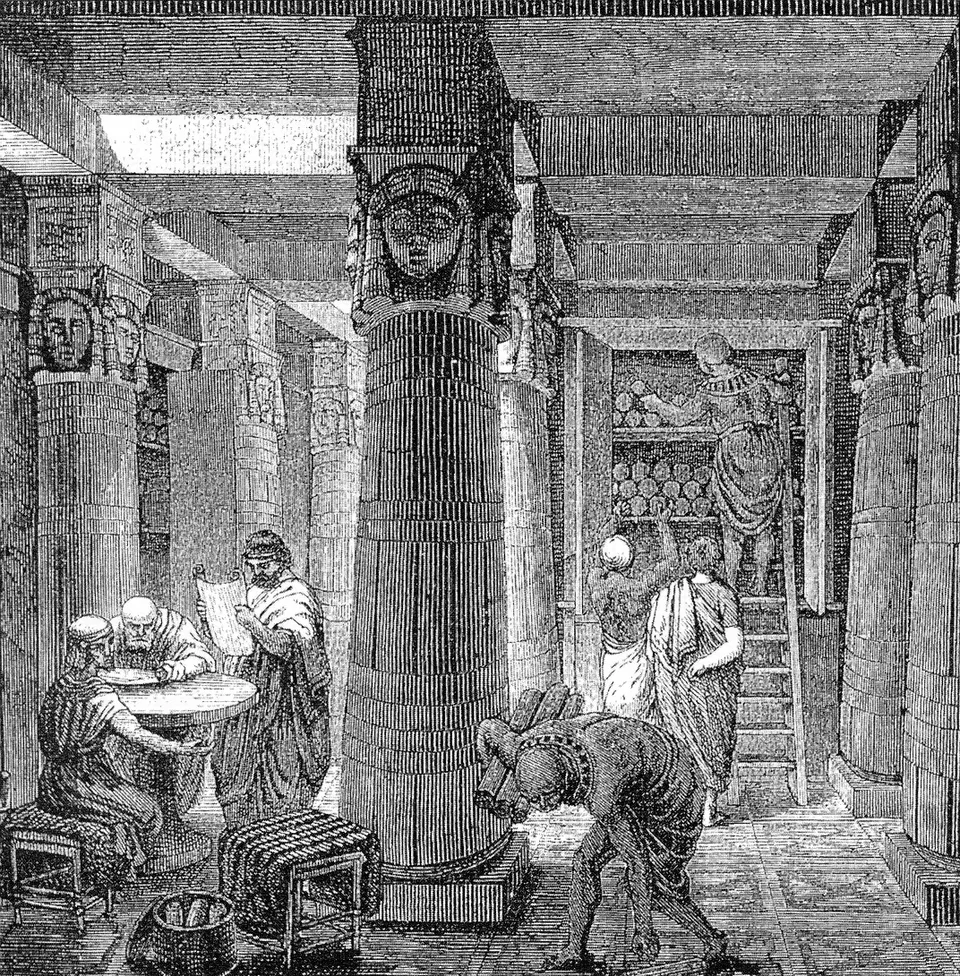
O. Von Corven · Public domain · Source
After Alexander’s death his empire was divided into Ptolemaic Egypt, Seleucid Syria, Antigonid Macedon and other kingdoms, where Greeks formed the ruling class and Greek (Koine) was widely spoken. The period from his death in 323 BC to Rome’s annexation of Ptolemaic Egypt in 30 BC is called the Hellenistic Age.
Its centre was Alexandria in Egypt, where the Ptolemies founded the Museum, a community of scholars, and a library said to hold hundreds of thousands of scrolls. There Euclid systematised geometry, Eratosthenes measured the Earth’s circumference fairly accurately and Aristarchus proposed that the Earth goes round the Sun; Archimedes of Sicily discovered the principles of buoyancy and the lever.
As the polis lost its importance, people sought individual happiness rather than the community. The Epicureans pursued pleasures of the mind and tranquillity, the Stoics urged mastering desire through reason, and Stoicism passed on to Rome. Art captured emotion and movement vividly, producing works such as the Venus de Milo and the Laocoön group.