Cheoyongmu
Also called: Cheoyong dance
A court dance derived from the tale of Cheoyong in the reign of King Heongang of Silla. Five dancers in Cheoyong masks wear the colours of the five directions; it became Intangible Cultural Heritage of Humanity in 2009.
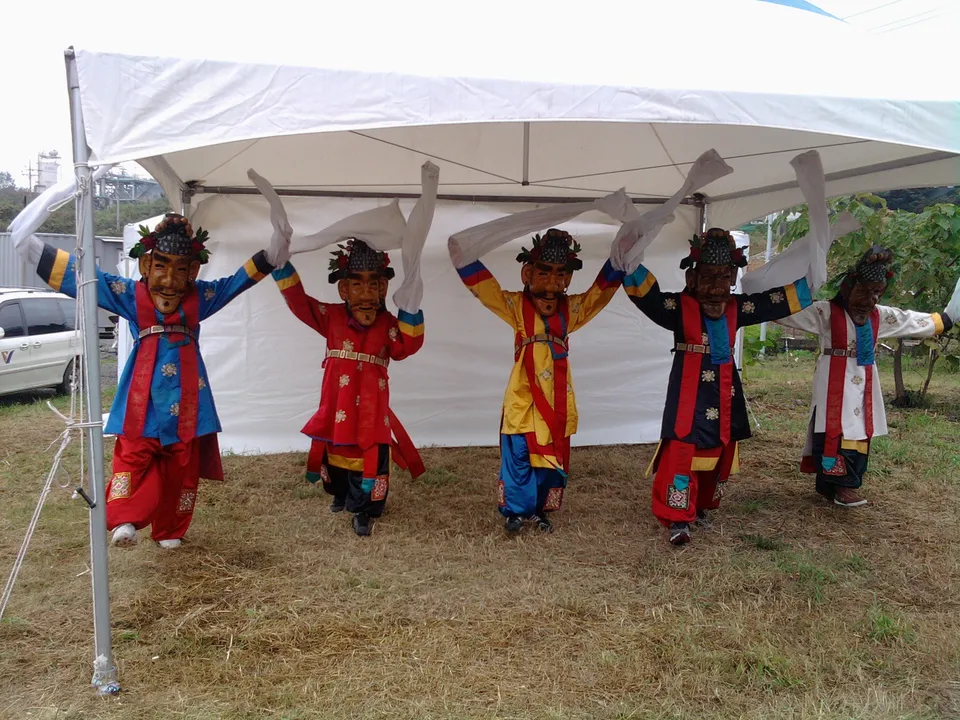
Sotiale · CC BY-SA 3.0 · Source
According to the Samguk yusa, when King Heongang went out to Gaeunpo (in today’s Ulsan), Cheoyong, a son of the Dragon of the East Sea, followed the king to Seorabeol and received an office. When the spirit of pestilence violated his wife, Cheoyong sang a song (the hyangga "Cheoyongga"), danced and withdrew; moved, the spirit swore never to enter a place bearing Cheoyong’s image. From then on people put Cheoyong’s face on their gates to drive away evil.
At the Goryeo and Joseon courts Cheoyongmu was danced in the year-end exorcism (narye) and at banquets. The Akhak gwebeom of King Seongjong’s reign describes the dance and masks in detail. It is danced by five Cheoyongs in blue, white, red, black and yellow, the colours of east, west, south, north and centre, so it is also called Obang Cheoyongmu. It is the only court dance performed in masks of human faces. It was inscribed by UNESCO as Intangible Cultural Heritage of Humanity in 2009.