Conflict209–206 BCE

The Chen Sheng–Wu Guang Uprising and the Fall of Qin

Also called: Dazexiang uprising

The year after the First Emperor died, conscripts on their way to the frontier rose under Chen Sheng and Wu Guang. The revolt spread across the country and Qin collapsed fifteen years after unification.
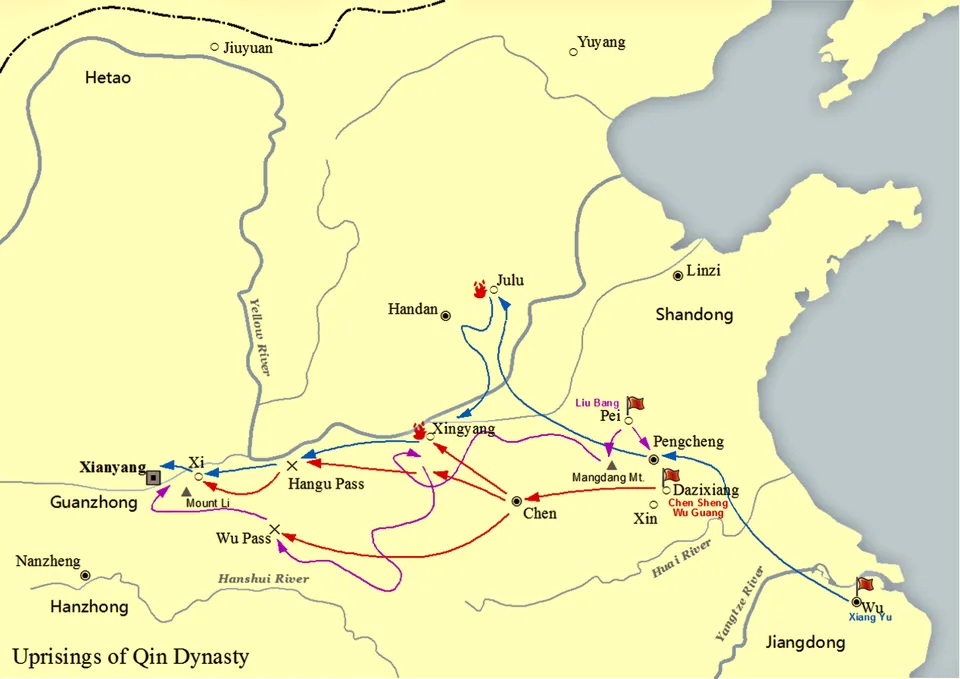
Uprisings at the end of Qin — the Chen Sheng–Wu Guang revolt and the rebel powers

SY · CC BY-SA 4.0 · Source

When the First Emperor died on tour at Shaqiu in 210 BCE, the eunuch Zhao Gao and the chancellor Li Si forged his will, forced his eldest son Fusu to die and set up Huhai as Second Emperor. Popular anger at huge building projects and harsh laws grew. In 209 BCE some nine hundred peasants being marched to frontier duty were delayed by heavy rain — under Qin law, lateness meant death — and Chen Sheng and Wu Guang led them in revolt at Dazexiang. Chen Sheng is remembered for asking, "Are kings, lords, generals and ministers born to their station?"

Chen Sheng founded Zhangchu at Chen and called himself king, but fell within half a year. The revolt, however, spread across the lands of the old six states, with Xiang Yu and Liu Bang of Chu at its centre. Xiang Yu crushed Qin’s main army at Julu in 207 BCE, and when Liu Bang reached Xianyang first, the Qin ruler Ziying surrendered and Qin fell. It was the first great peasant uprising in Chinese history.

The map in 209 BC

OpenFreeMap © OpenMapTiles © OpenStreetMap contributors

States at the time
Qin · fell
Places
Xianyang

People

  • Chen Sheng208 BC

    leader · Peasant rebel at the end of Qin who rose with Wu Guang at Dazexiang in 209 BCE, founded Zhangchu and proclaimed himself king

  • Qin Shi Huang259 BC – 210 BC

    related figure · King of Qin (247–221 BCE) and first emperor (221–210 BCE) who conquered the six other states, unified China and created a centralised imperial system

  • Xiang Yu232 BC – 202 BC

    commander · General from a noble Chu family who destroyed Qin’s main army and became Hegemon-King of Western Chu, but killed himself after losing to Liu Bang at Gaixia

  • Liu Bang (Emperor Gaozu of Han)195 BC

    commander · First emperor of Han (r. 202–195 BCE), a petty official from Pei who defeated Xiang Yu in the Chu–Han contention and founded the dynasty

Before and after

Themes that include this event

  • Ancient China and India770 BC – AD 220

    From the Hundred Schools of the Warring States to the unified empires of Qin and Han, and from the Buddha to the Maurya and Kushan empires — the millennium that shaped East and South Asian civilisation