Bosnian Annexation Crisis
Also called: Bosnian Crisis, Annexation of Bosnia and Herzegovina
When Austria-Hungary formally annexed Bosnia and Herzegovina, which it had been administering, Serbia and Russia protested fiercely. Germany backed Austria and Russia gave way.
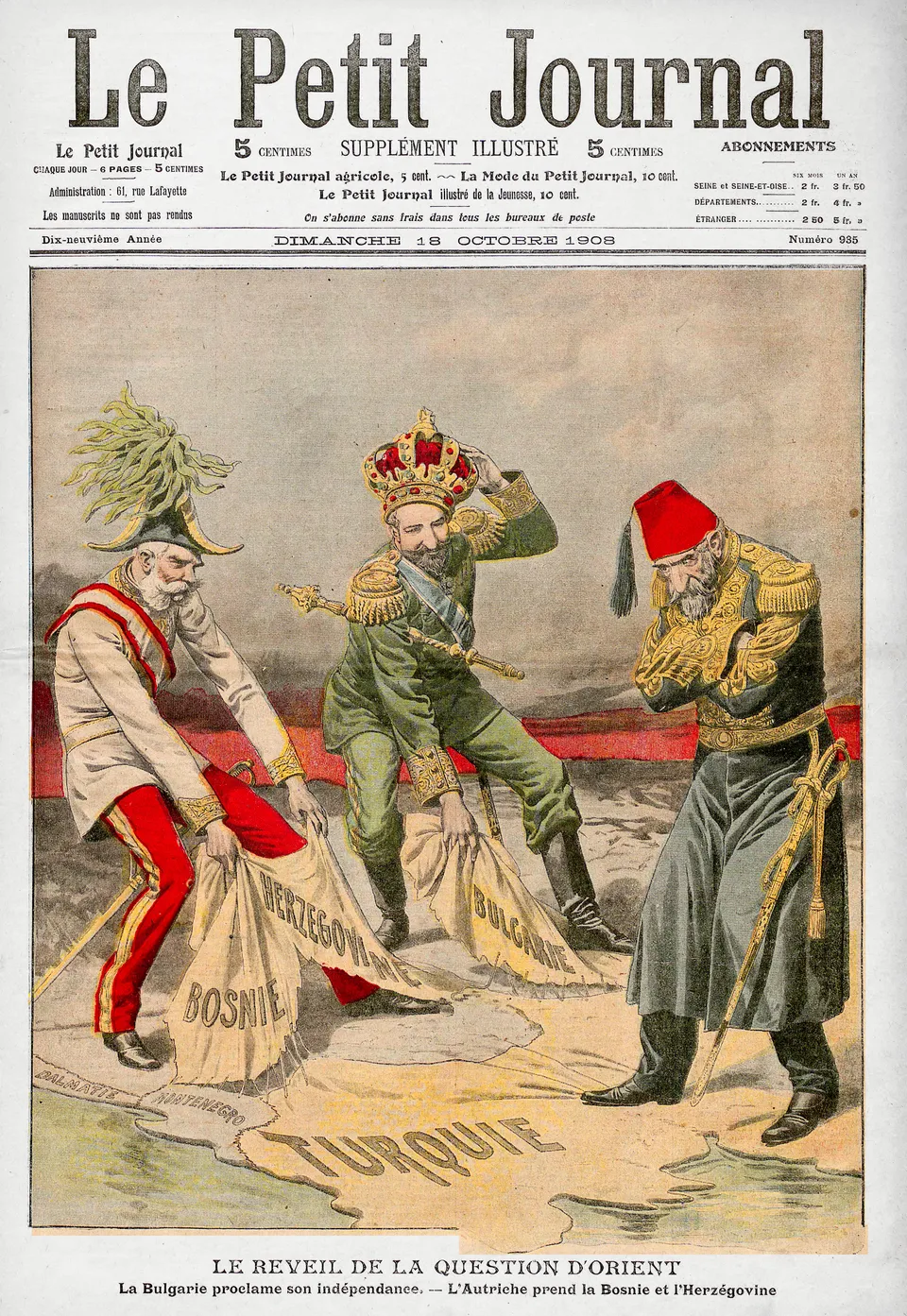
Unknown author · Public domain · Source
Since the Congress of Berlin in 1878 Bosnia and Herzegovina had remained Ottoman territory in name while Austria-Hungary governed it. With the Ottoman Empire shaken by the Young Turk Revolution, Austria announced the formal annexation of the provinces on 6 October 1908; a day earlier Bulgaria had declared full independence from the Ottomans.
Serbia, which hoped to unite the South Slavs, was outraged, and Russia, which saw itself as protector of the Slavs, protested as well. But when Germany stood firmly behind Austria, a Russia still weakened by its defeat in the Russo-Japanese War accepted the annexation in 1909.
Humiliated, Russia rearmed and drew closer to Serbia, and the rivalry of Pan-Germanism and Pan-Slavism sharpened. The crisis began the Balkans’ career as the “powder keg of Europe”, and the Sarajevo assassination six years later grew out of resentment at the annexation.