Conflict23 August 1942 – 2 February 1943

Battle of Stalingrad

German and Soviet forces fought for more than five months in the streets of Stalingrad on the Volga. The Soviets encircled and forced the surrender of the German Sixth Army, turning the tide of the war in the east.
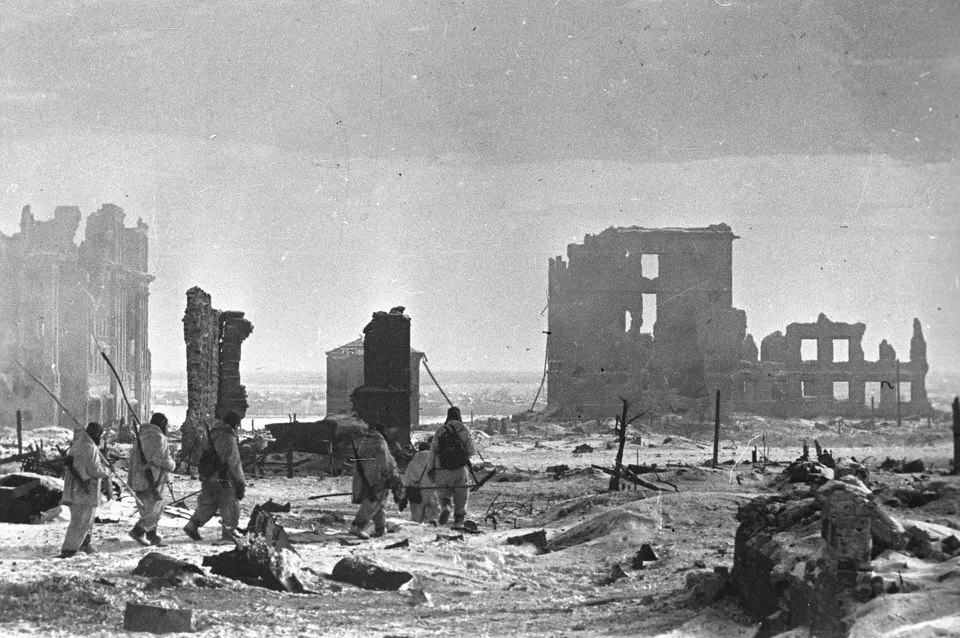
The ruined centre of Stalingrad after the battle — Georgy Zelma, 2 February 1943

Zelma / Георгий Зельма · CC BY-SA 3.0 · Source

In summer 1942 the Germans drove south towards the Caucasus oil fields and attacked Stalingrad. Bombing reduced the city to ruins, and the fighting went on building by building and factory by factory.

On 19 November Soviet forces broke through the weak Romanian lines on either side of the city and encircled some 300,000 men of the German Sixth Army (Operation Uranus). Hitler forbade a breakout; the trapped army starved and froze, and on 2 February 1943 its last 90,000 or so surrendered. Casualties on both sides are estimated at close to two million, making it one of the bloodiest battles in history.

The map in 1942

OpenFreeMap © OpenMapTiles © OpenStreetMap contributors

States and rulers at the time
Soviet Union · victor — Leader Joseph Stalin
Germany · defeated
Places
Stalingrad

People

  • Georgy Zhukov1896 – 1974

    commander · Marshal of the Soviet Union who directed the defence of Moscow, the Stalingrad counter-offensive and Kursk, and took Berlin

  • Joseph Stalin1878 – 1953

    related figure · General Secretary of the Soviet Communist Party who ruled the USSR from the late 1920s until his death, led the war against Germany and drew Eastern Europe into the Soviet bloc

  • Adolf Hitler1889 – 1945

    related figure · Nazi leader and Führer of Germany (1934–1945) who started the Second World War and perpetrated the Holocaust; he killed himself as Berlin fell

Before and after

Earlier
1942 Battle of Midway

Themes that include this event

  • World War II1939 – 1945

    From the invasion of Poland to the surrender of Japan — the largest war in human history, across Europe, Asia and the Pacific