The Ara Pacis — Altar of Augustan Peace
Also called: Ara Pacis Augustae, Altar of Peace
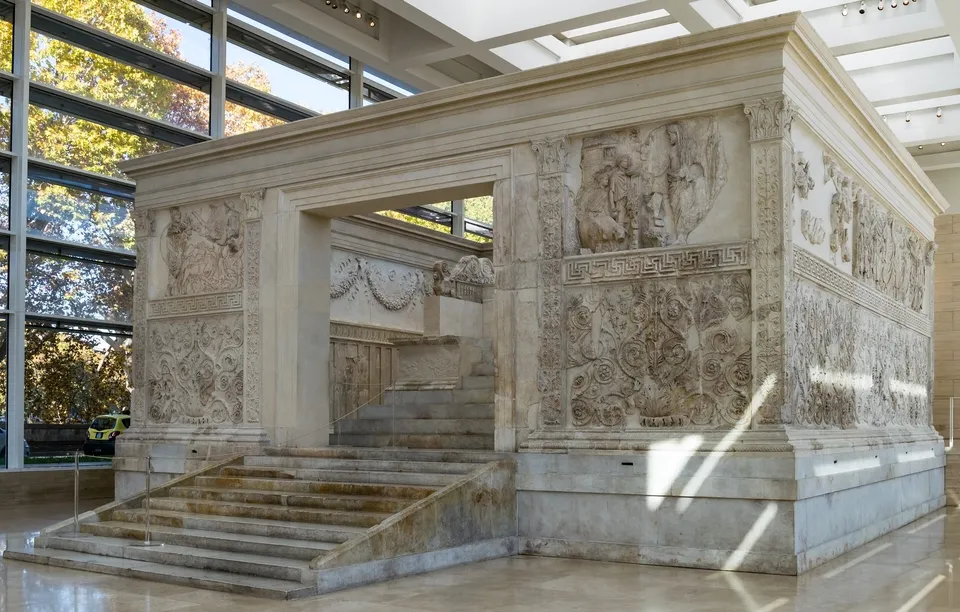
In 13 BC the Senate voted an altar of peace to honour Augustus on his return from Spain and Gaul, and on 30 January 9 BC it was dedicated on the Campus Martius. Its west front shows the twins at the wolf’s cave (the Lupercal) and a sacrifice by a figure usually identified as Aeneas.
Rabax63 · CC BY-SA 4.0 · Source
On 4 July 13 BC the Senate voted to build the “Altar of Augustan Peace” to honour Augustus on his return from Spain and Gaul, and on 30 January 9 BC it was dedicated beside the Via Flaminia on the Campus Martius north of Rome; Augustus recorded it in his Res Gestae. The altar stands within a marble enclosure whose outer north and south walls show processions of Augustus, his family, priests and officials, while mythological and allegorical reliefs flank the east and west entrances.
On the left of the west front is the Lupercal scene (badly damaged), with the wolf nursing the twins watched by Mars and the shepherd Faustulus; on the right, a veiled elder sacrifices a sow before a shrine of the Penates. The elder was long read as Aeneas arriving at Lavinium, though some identify him as Numa, Rome’s second king. Setting Rome’s two founders side by side, the reliefs tie the Augustan peace to the city’s beginnings.
Buried in the Middle Ages, the altar began to reappear in fragments under the Palazzo Fiano from 1568, and these were scattered among several museums. In 1937–1938 the remaining parts were dug out by freezing the waterlogged ground, and with the scattered pieces reassembled beside the Mausoleum of Augustus. A museum building designed by Richard Meier opened in 2006.