Conflict9 April 1865

Surrender at Appomattox

Also called: Appomattox Court House, Lee’s surrender

Driven from Richmond, Lee surrendered the Army of Northern Virginia to Grant at Appomattox Court House, effectively ending the Civil War.
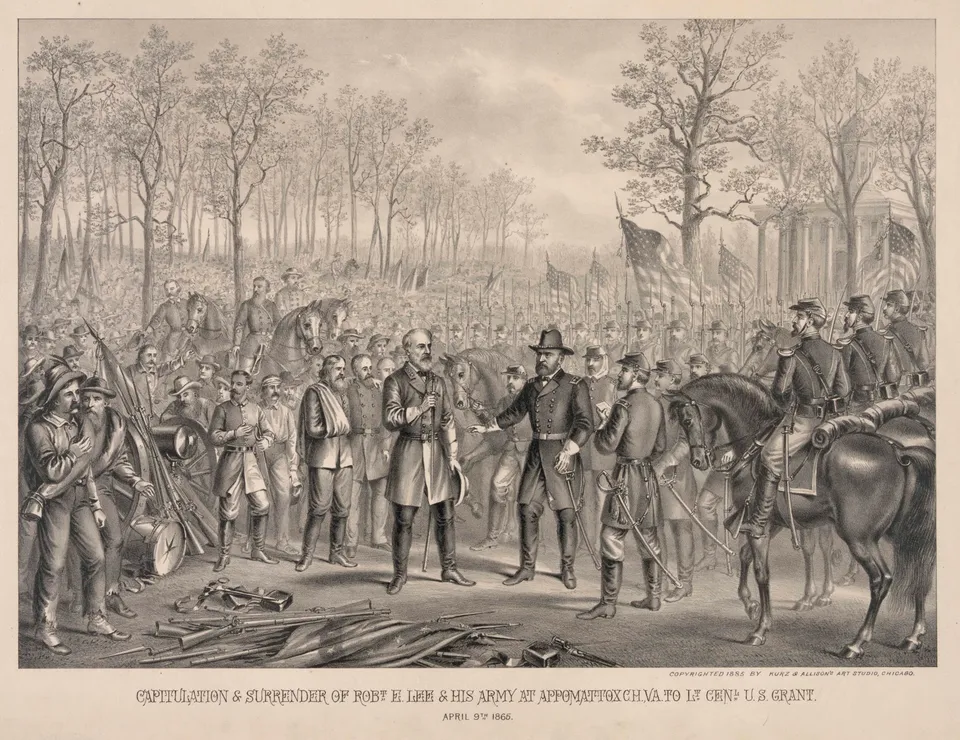
Lee surrendering to Grant at Appomattox — Kurz & Allison lithograph, c. 1885, Library of Congress

Curz&Allison · Public domain · Source

After holding Petersburg for more than nine months from June 1864, Lee’s army saw its lines broken on 2 April 1865 and abandoned Richmond, fleeing west. With his escape blocked, Lee met Grant on 9 April in Wilmer McLean’s house in the village of Appomattox Court House and signed the surrender.

Grant offered generous terms: Confederate soldiers could go home on parole, officers kept their sidearms and men who owned horses kept them for the spring ploughing, and 25,000 rations were sent to the starving Confederates. The remaining Confederate forces laid down their arms by June — Joseph Johnston surrendered to Sherman on 26 April — and Jefferson Davis was captured in Georgia on 10 May.

The map in 1865

OpenFreeMap © OpenMapTiles © OpenStreetMap contributors

States and rulers at the time
United States · victor — President Abraham Lincoln
Places
Appomattox Court House, Richmond

People

  • Ulysses S. Grant1822 – 1885

    commander · Union general who took Vicksburg, became general-in-chief in 1864 and received Lee’s surrender; 18th US president (1869–1877)

  • Robert E. Lee1807 – 1870

    commander · Confederate general who led the Army of Northern Virginia to many victories, lost at Gettysburg and surrendered at Appomattox in 1865

  • Jefferson Davis1808 – 1889

    related figure · Mississippi politician, former US secretary of war and senator, and the only president of the Confederacy (1861–1865)

Before and after

Themes that include this event

  • The American Civil War1850 – 1865

    From the Compromise of 1850 to Lincoln’s assassination — a nation divided over slavery fought four years of civil war, preserving the Union and ending slavery