Thor Fishing for Jörmungandr
Also called: Thor’s fishing trip, Hymiskviða, Midgard Serpent, Jormungand, Midgardsormr
A legend handed down over the centuries.
A Norse myth told in the Eddic poem Hymiskviða and Snorri’s Prose Edda, and carved on stones such as the 11th-century Altuna Runestone in Sweden. Thor goes fishing with the giant Hymir and, using an ox head as bait, hauls up Jörmungandr, the Midgard Serpent — until the terrified Hymir cuts the line.
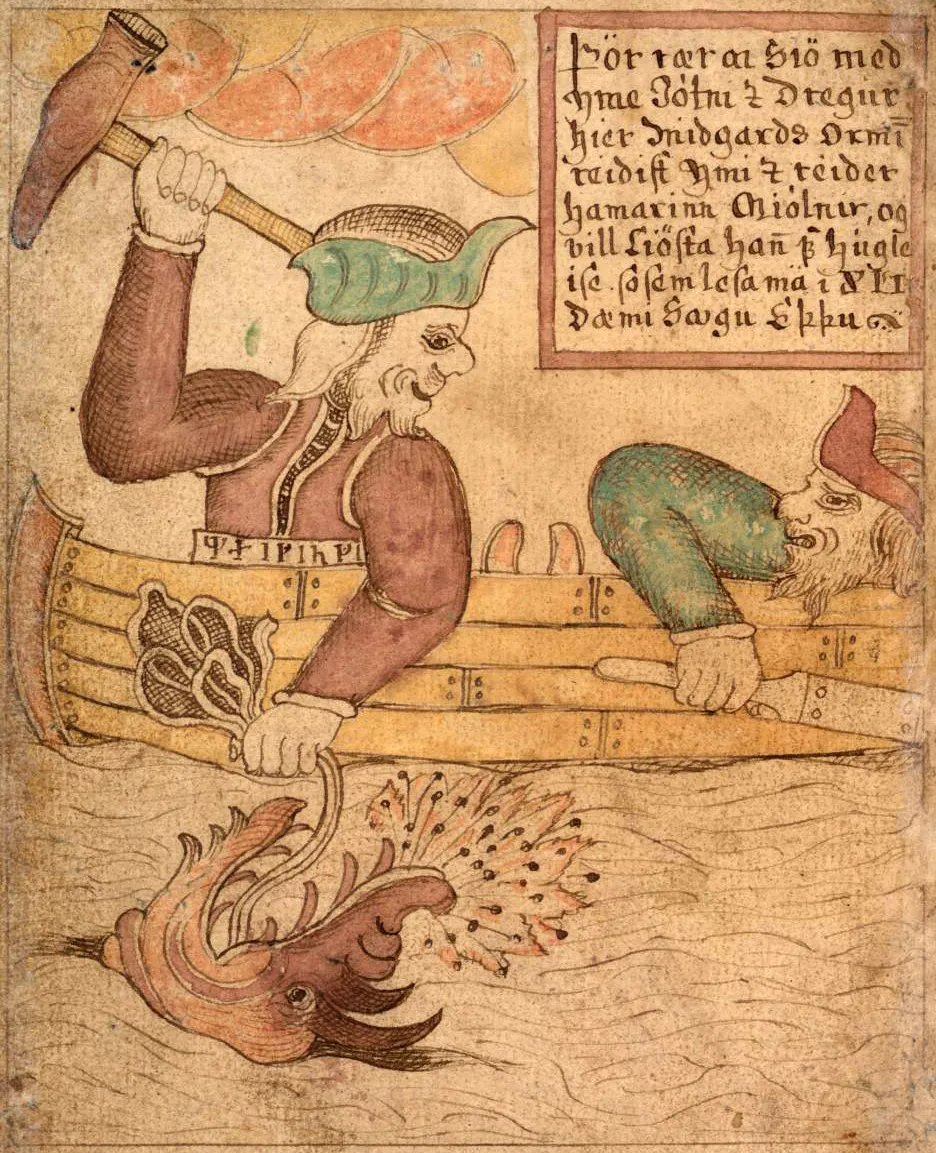
Jakob Sigurðsson [2] · Public domain · Source
This Norse myth is told in the Eddic poem Hymiskviða and in Gylfaginning of Snorri Sturluson’s Prose Edda, and 10th-century skaldic poems (Bragi’s Ragnarsdrápa, Úlfr Uggason’s Húsdrápa) also describe the scene. Most of the sources were written down by Christians in 13th-century Iceland, but because the scene is carved on Viking Age stones, the story is clearly older.
According to Snorri, Thor, disguised as a youth, stayed with the giant Hymir and went fishing with him. For bait he wrenched the head off Hymir’s largest ox, then rowed so far out to sea that Hymir grew afraid. When the Midgard Serpent took the bait, Thor pulled with all his divine strength until both his feet went through the bottom of the boat onto the sea floor, and the serpent’s head rose from the water to glare at him.
As Thor raised his hammer, the terrified Hymir cut the line and the serpent sank back into the sea. Snorri notes that some say Thor struck off its head, but that the serpent in fact survived; the two foes meet again at Ragnarök. Since the Altuna Runestone shows Thor’s foot thrust through the boat’s bottom, the story is attached here to that stone.