Thor at the Castle of Útgarða-Loki
Also called: Útgarða-Loki, Utgard-Loki, Utgard, Skrýmir, Thor and Elli
A legend handed down over the centuries.
A Norse myth told in Gylfaginning of Snorri’s Prose Edda. Thor and Loki travel to the giants’ stronghold of Útgarðr and lose every contest — eating, running, drinking, lifting a cat and wrestling — only to learn they had been pitted against fire, thought, the sea, the Midgard Serpent and old age.
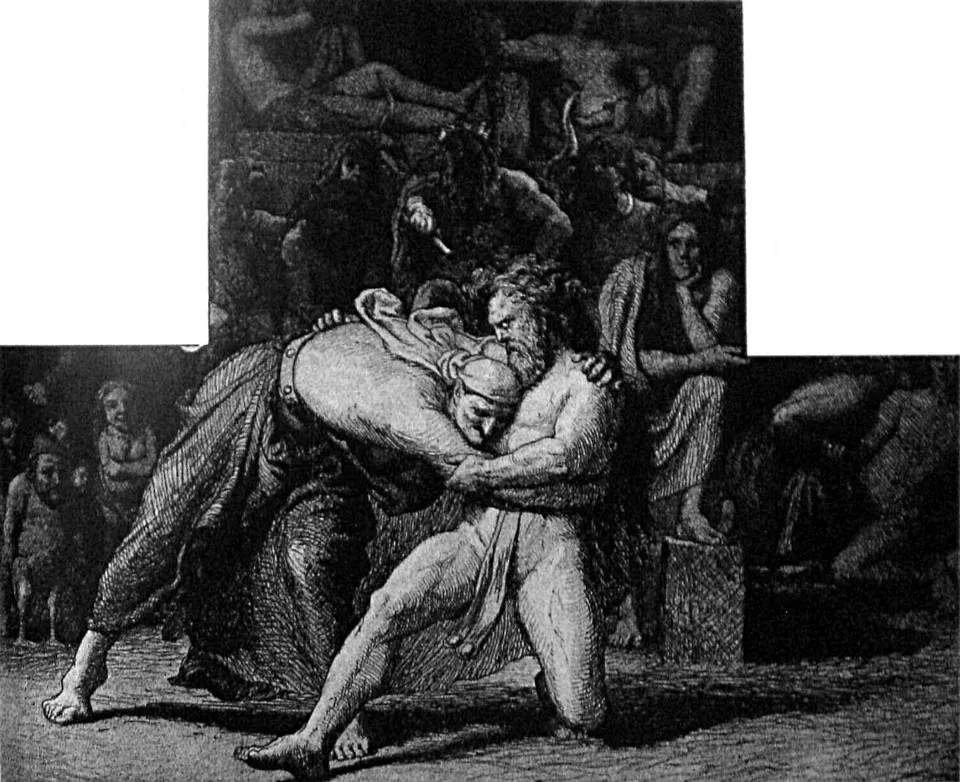
Lorenz Frølich · Public domain · Source
This Norse myth is told in Gylfaginning, part of Snorri Sturluson’s Prose Edda. Thor, the thunder god, set out for the land of the giants with Loki and the peasant children Þjálfi and Röskva. The great hall where they spent a night in the forest turned out to be the glove of the giant Skrýmir, and when Thor struck the sleeping giant’s head three times with his hammer Mjölnir, the giant woke wondering whether a leaf had fallen on him.
At the castle of Útgarðr its king, Útgarða-Loki, set his guests contests. Loki lost an eating match to Logi and Þjálfi a race to Hugi. Thor could not empty a drinking horn in three draughts, could lift only one paw of a great grey cat, and was brought to one knee wrestling the old nurse Elli.
As they left the next day, Útgarða-Loki revealed that all had been illusion. He himself had been Skrýmir, and Thor’s blows had struck a mountain, leaving valleys; Logi was fire, Hugi thought, the end of the horn lay in the sea (hence the ebb tide), the cat was the Midgard Serpent, and Elli was old age, whom no one can defeat. When Thor raised his hammer, castle and giant vanished. The tale appears in no older poem, and some scholars think Snorri built it on folktales.