Partition of Bengal and the Swadeshi Movement
Also called: Partition of Bengal, Swadeshi movement, Calcutta Congress resolutions
When Britain split Bengal, heartland of Indian nationalism, into Hindu- and Muslim-majority halves, the Indian National Congress answered with four resolutions: boycott, swadeshi, swaraj and national education.
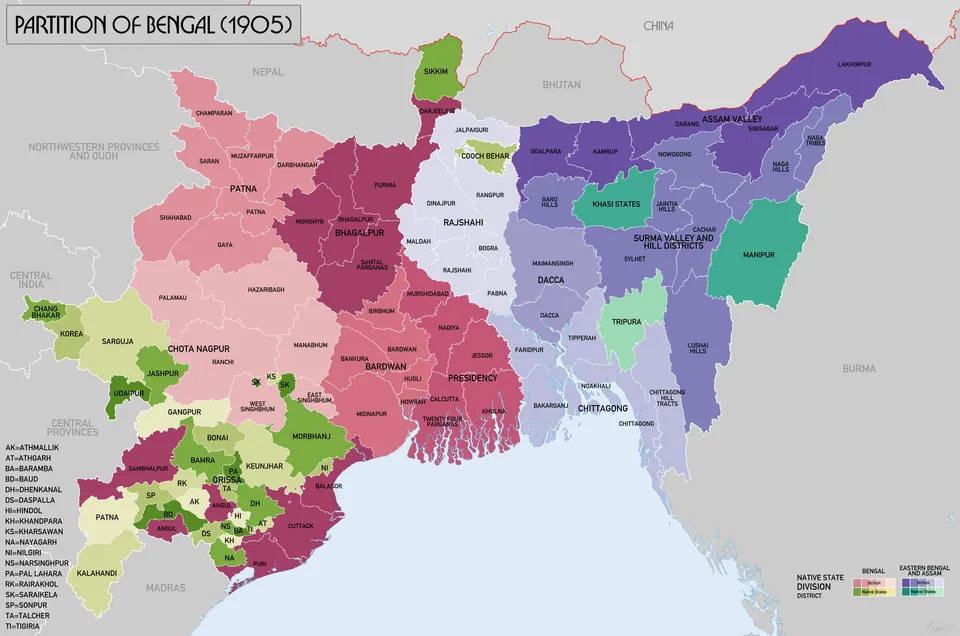
XrysD · CC BY-SA 4.0 · Source
In 1905 the viceroy Lord Curzon, citing administrative efficiency, divided the province of Bengal into a Hindu-majority West Bengal and a Muslim-majority Eastern Bengal and Assam (in force from 16 October). It was divide and rule, aimed at weakening Bengal, the centre of the national movement, by splitting it along religious lines.
Protest spread across India. At its Calcutta session in 1906 the Indian National Congress adopted four resolutions — boycott of British goods, swadeshi (buying Indian goods), swaraj (self-rule) and national education — and radicals such as Tilak led the movement. In 1906 Britain encouraged Muslims to found the All-India Muslim League, seeking to divide Hindus and Muslims.
While repressing the movement and jailing Tilak, Britain finally revoked the partition in 1911 and moved the capital from Calcutta to Delhi.