Politics29–30 September 1938

Munich Agreement

Also called: Munich Pact, Appeasement, Sudeten crisis

The leaders of Britain, France, Italy and Germany met in Munich and, without Czechoslovakia, agreed to hand the Sudetenland to Germany — the high point of appeasement.
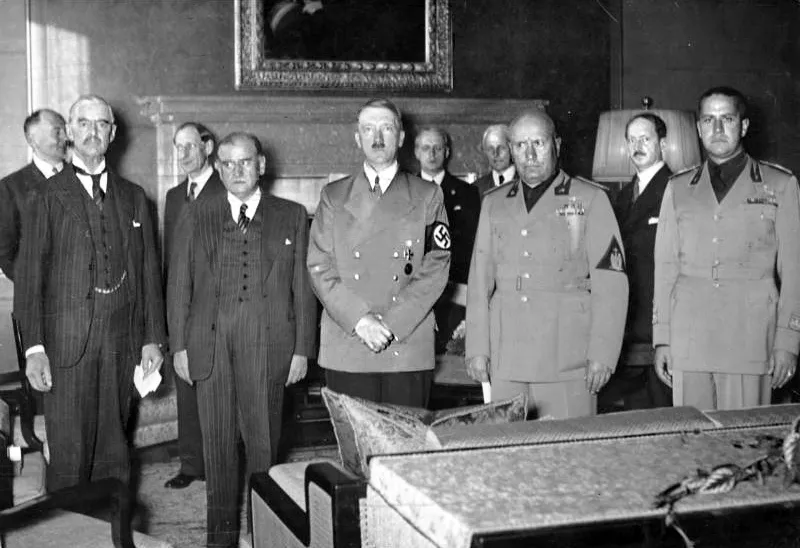
Chamberlain, Daladier, Hitler, Mussolini and Ciano (from left) at the Munich conference, 29 September 1938

Unknown author · CC BY-SA 3.0 de · Source

Some three million ethnic Germans lived in the Sudetenland, the border region of western Czechoslovakia. Fresh from annexing Austria, Hitler claimed they were oppressed, demanded the territory and threatened war. British prime minister Chamberlain twice flew to Germany to see Hitler, and with Mussolini as mediator, Chamberlain, French prime minister Daladier, Mussolini and Hitler met in Munich on 29 September 1938. Czechoslovakia itself and the Soviet Union were not invited.

Under the agreement, signed in the early hours of the 30th, Czechoslovakia had to give up the Sudetenland by 10 October. Chamberlain spoke of “peace for our time”, but in March 1939 Hitler broke the agreement, entered Prague, made the Czech lands a protectorate and split off Slovakia. Only then did Britain and France abandon appeasement and guarantee Poland’s independence. The Soviet Union, now distrustful of the West, turned towards a deal with Germany.

The map in 1938

OpenFreeMap © OpenMapTiles © OpenStreetMap contributors

States at the time
Germany · signatory
Great Britain · signatory
France · signatory
Italy · signatory
Czechoslovakia · targeted
Places
Munich

People

  • Adolf Hitler1889 – 1945

    leader · Nazi leader and Führer of Germany (1934–1945) who started the Second World War and perpetrated the Holocaust; he killed himself as Berlin fell

  • Neville Chamberlain1869 – 1940

    diplomat · British prime minister (1937–1940) who pursued appeasement of Hitler and signed the Munich Agreement, then declared war after the invasion of Poland

  • Édouard Daladier1884 – 1970

    diplomat · French Radical politician who signed the Munich Agreement as prime minister (1938–1940)

  • Benito Mussolini1883 – 1945

    diplomat · Founder of Italian Fascism who became prime minister (1922–1943) after the March on Rome; dictator who invaded Ethiopia and allied with Hitler

Before and after

Later
1938 Kristallnacht

Themes that include this event

  • The Great Depression and Totalitarianism1919 – 1939

    From the Washington Conference to the invasion of Poland — two decades in which the age of international cooperation collapsed in the Depression, fascism, Nazism and Stalinism rose, and the world slid into war again