Ginnungagap and Ymir — The Beginning of the World
Also called: Ginnungagap, Ymir, Audhumla, Ask and Embla, Norse creation myth
A legend handed down over the centuries.
The Norse creation myth, told in the Völuspá (Prophecy of the Seeress) of the Poetic Edda and in Gylfaginning (The Deluding of Gylfi) of Snorri’s Prose Edda. In Ginnungagap, the empty gap between icy Niflheim and fiery Muspelheim, the giant Ymir came into being; Odin and his brothers killed him and made the world from his body.
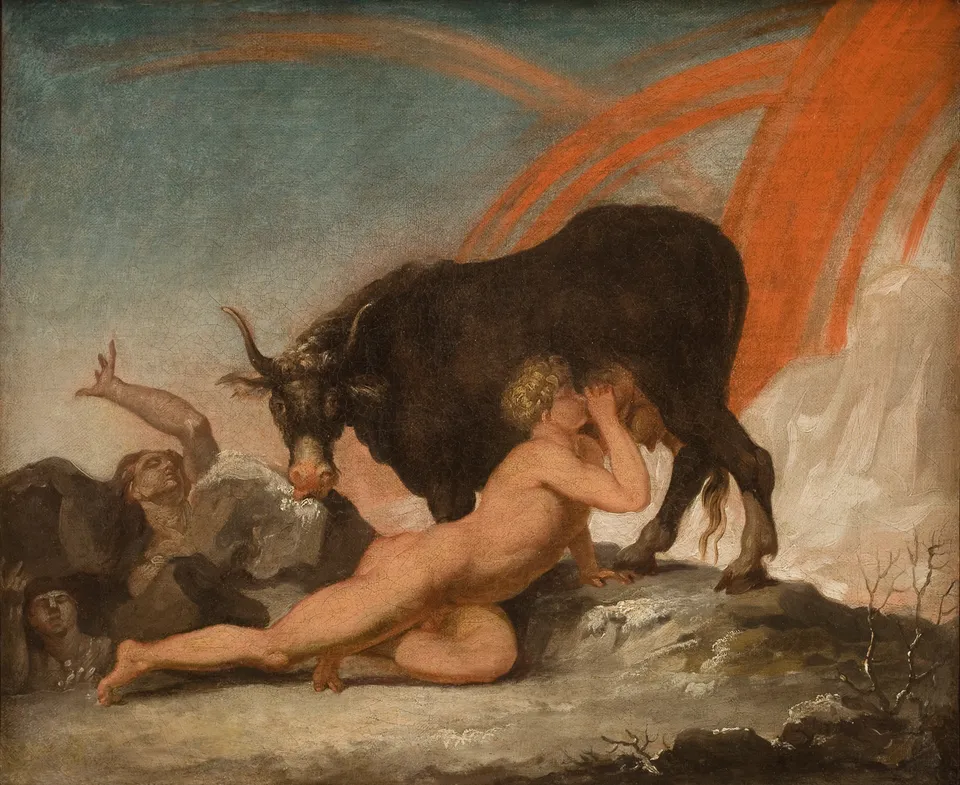
Nicolai Abildgaard · Public domain · Source
This Norse creation myth is told in the Eddic poems Völuspá, Vafþrúðnismál and Grímnismál and in Gylfaginning, part of Snorri Sturluson’s Prose Edda. Most of these sources were written down by Christians in 13th-century Iceland, so how closely they match pagan belief is unknown. Völuspá begins: “there was no sand nor sea nor cool waves, no earth nor heaven above — only Ginnungagap, the yawning gap.”
According to Snorri, between Niflheim, the world of ice in the north, and Muspelheim, the world of fire in the south, drops from the melting ice gave life to the frost giant Ymir. The cow Auðumbla fed him with her milk, and as she licked the salty ice Búri, ancestor of the gods, came forth. Búri’s grandsons Odin, Vili and Vé killed Ymir, and nearly all the frost giants drowned in the flood of his blood.
The brothers made the earth from Ymir’s flesh, the sea from his blood, the mountains from his bones and the sky from his skull, held up at its four corners by four dwarves. With his eyebrows they fenced Midgard, the land of men, against the giants, and from two trees on the shore they made the first man and woman, Ask and Embla.