Gangneung Danoje Festival
Also called: Gangneung Danoje Festival
A Gangneung town festival honouring the gods of Daegwallyeong at Dano, the 5th day of the 5th lunar month. Heo Gyun recorded seeing it in 1603; it became Intangible Cultural Heritage of Humanity in 2005.
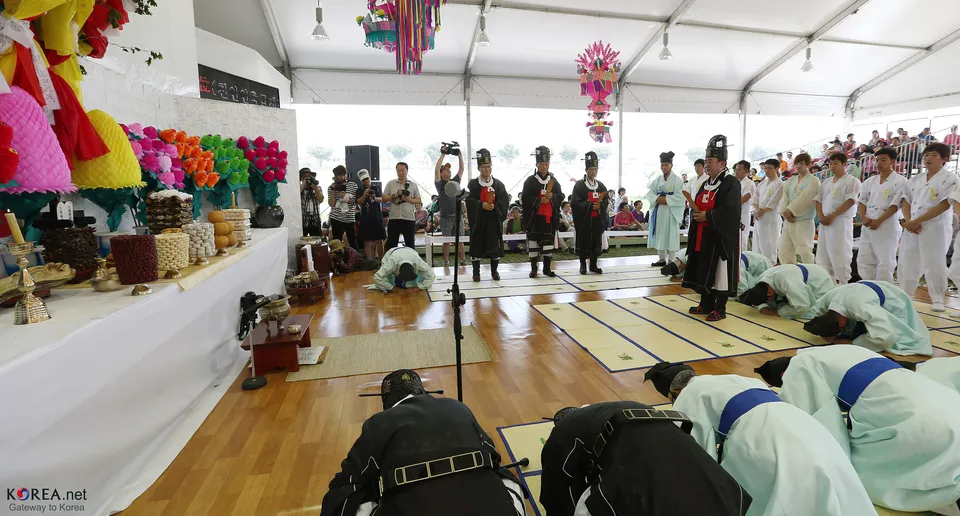
Korea.net / Korean Culture and Information Service (Jeon Han) · CC BY-SA 2.0 · Source
Dano (Surit-nal), the 5th day of the 5th lunar month, was a holiday to pray for a good harvest after rice transplanting. In Gangneung the mountain god and the guardian deity were brought down from Daegwallyeong pass for rites, followed by shamanic rituals and games on a large scale. Heo Gyun wrote that in 1603 he saw the townspeople bring down and entertain the mountain god of Daegwallyeong (Kim Yu-sin). The guardian deity is said to be the late-Silla monk Beomil.
Confucian rites, the shaman’s Dano gut and the Gangneung Gwanno mask drama, performed entirely in gesture without words, take place together, along with Dano customs such as swinging, ssireum wrestling and washing hair in iris water. It is distinctive as a town festival run jointly by the local government and the people. It was proclaimed by UNESCO in 2005 (then as a "Masterpiece"), now Intangible Cultural Heritage of Humanity.