Dido and Aeneas
Also called: Dido, Elissa, Queen of Carthage
A legend handed down over the centuries.
A Roman myth sung in Books 1 and 4 of Virgil’s Aeneid. Driven by a storm to Carthage, Aeneas fell in love with Dido, the queen who had founded the city; when the gods ordered him on to Italy, Dido took her own life, calling down eternal enmity between their peoples.
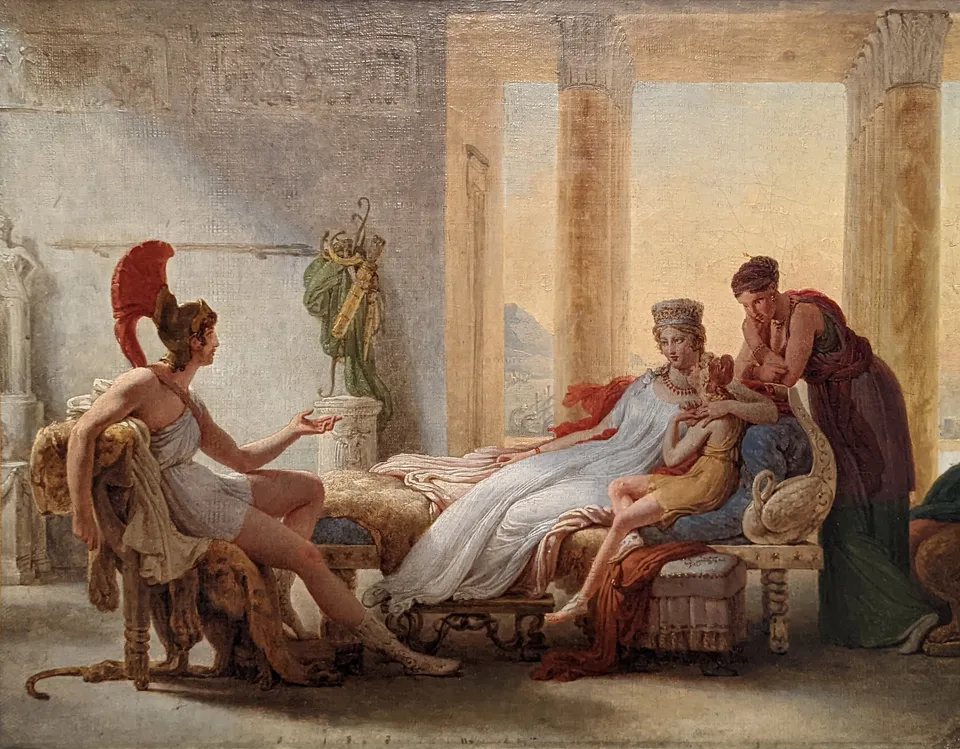
Pierre-Narcisse Guérin · Public domain · Source
This Roman myth is sung in Books 1 and 4 of Virgil’s Aeneid and retold in Ovid’s Heroides 7 as a letter from Dido. Dido (Elissa), a princess of the Phoenician city of Tyre, fled with her followers to North Africa after her brother King Pygmalion murdered her husband, and founded Carthage. One story says she bargained for only as much land as an oxhide could cover, then cut the hide into thin strips to enclose a whole hill, the Byrsa. Aeneas, after seven years of wandering since Troy, was driven to Carthage by a storm raised by Juno (Hera), and at Dido’s banquet told of the fall of Troy and his journeys (Books 2–3).
Through Cupid, sent by Venus, Dido fell in love with Aeneas, and the two were united in a cave where they had sheltered from a storm during a hunt. But Jupiter sent Mercury to urge Aeneas on to Italy, and he slipped away with his ships. Abandoned, Dido mounted a pyre and killed herself with his sword, cursing her people and his descendants with endless enmity. Romans read this curse as the mythical cause of the Punic Wars between Rome and Carthage.
Carthage was a real city, but ancient historians dated its founding to about 814 BC — more than three centuries after the fall of Troy (c. 1184 BC by Eratosthenes) — so the two could not have lived at the same time. For this reason the story is not placed on the map or the timeline. Some think the Roman poet Naevius, before Virgil, first linked the two. Purcell’s opera Dido and Aeneas (c. 1689) is based on the story.